Author: Vi-M Professional Solutions

  • Going Digital Human Resources – Free Webinar for all Employers and Employees

    Vi-M Professional Solutions is delighted to announce the SIXTH SESSION of its ‘Going Digital Nigeria’ free webinar series, on the topic “Going Digital, Human Resources”, taking place on 8th July 2020 by 12PM (WAT).

    We are thrilled at the line-up and are pleased to introduce the following persons / prominent brands as our panelists for the session:

    1. SANDRA CROUS – Managing Director, PaySpace
    2. UKINEBO DARE – Managing Director, Edo State Skills Development Agency
    3. INNOCENT OSEGHE – Managing Partner, Human Capital Partners (HCP)
    4. DAVID BROWN (FCA) – Founder & Managing Partner, dbrownconsulting
    5. OLUSOLA AYODELE – Economist of the Nigeria Employers’ Consultative Association (NECA)

    These giant panelists will review / discuss amongst other things, how businesses are managing human resources (employees) in the face of the pandemic, available technology for human resources – a review of PaySpace, expectations from employees in the ‘New Normal’, strengthening enabling legislations and a review of working from home.

    To Register please visit www.vi-m.com/webinars.

    For enquiries, contact Vivian Chigozie-Nmonwu &/or Magnus Nmonwu via clients@vi-m.com / www.vi-m.com.

    Let’s go digital Nigeria – #RegisterNow!

  • Going Digital Nigeria 5- Webinar for Nigerian Manufacturers

    We are super excited to announce our 5TH EDITION of our “Going Digital Nigeria” webinar series on the theme, “GOING DIGITAL MANUFACTURING”, coming up on 1 July, 2020 at 12.00pm (WAT).

    Once again, we feel very much honoured to introduce our PANELISTS for this 5th session:

    1. Oruche Ambrose (FCIBN, ANIPR), the Acting Director General of the Manufacturers Association of Nigeria (MAN), a professional administrator with over 30 years of experience across diverse industries, including banking, security, business enterprise, private and public sector development. Amongst many contributions he has made, Oruche was on the committee that determined products exportable in Nigeria, coordinated by Central Bank of Nigeria (CBN) – 1997-1998; was part of UNIDO Information Networking for Technology, Investment & Business (INTIB) programme – 1997-1999; was involved in a Country wide Survey on companies that can be included for investment promotion, organized by NIPC & UNIDO– 2001-2002; took part in TECHNO-Economic Survey of MAN’s ten industrial Sectors, conducted by Raw Materials Research & Development Council (RMRDC) – 2003-2007; and represented Nigeria Private Sector on ECOWAS Common External Tariff and ECOWAS-EU Economic Partnership Agreement Negotiations.
    2. Professor Ndubuisi Ekekwe (MBA, PHD), the founder of Zenvus and Chairman of Fasmicro Group. A recipient of IGI Global “Book of the Year” Award, a TED Fellow, IBM Global Entrepreneur and World Economic Forum Young Global Leader. Prof Ndubuisi Ekekwe invented and patented a robotic system used in minimal invasive medical robots. The United States Government acquired assignee rights to the technology in 2017. He holds two doctoral and four master’s degrees including PhD in electrical and computer engineering from the Johns Hopkins University, USA. Dr Ekekwe has held professorships in Carnegie Mellon University and Babcock University, and served in the United States National Science Foundation ERC E&D Committee. He is also a selection board member of the $100 Million Tony Elumelu Entrepreneurship Program.
    3. Chinedum Ucheoma, an Oracle NetSuite Sales Manager overseeing the Nigerian Market. He has over 10 years experience in business consulting, software advisory and implementation. He is an experienced professional with a strong progressive history of driving dynamic growth of new and existing businesses, services and product sales, client/customer relationship management across various industry sectors within emerging markets and most importantly increase revenues and profitability through business automation.
    4. Samir Ougouag, a Senior Solution Consultant, working on Oracle NetSuite and Oracle EPM solutions. Samir has a rich experience in implementing Finance, Supply Chain Management and project modules for various industries (Oil and Gas, Distribution, Manufacturing, Media & Publishing, Non-Profit, Projects and Services, etc.). He has helped many businesses choose their ERP systems and managed the successful implementation of various applications. He is skilled in ERP project management and change management towards adopting a digital culture.

    They will discuss how manufacturers in Nigeria are navigating the Covid-19 pandemic, the use/importance of technology & how digitalization of processes has helped or will continue to help Manufacturing Businesses in the face of the pandemic and beyond.

    Registration is still open at www.vi-m.com/webinars.

    Let’s go digital Nigeria!!!

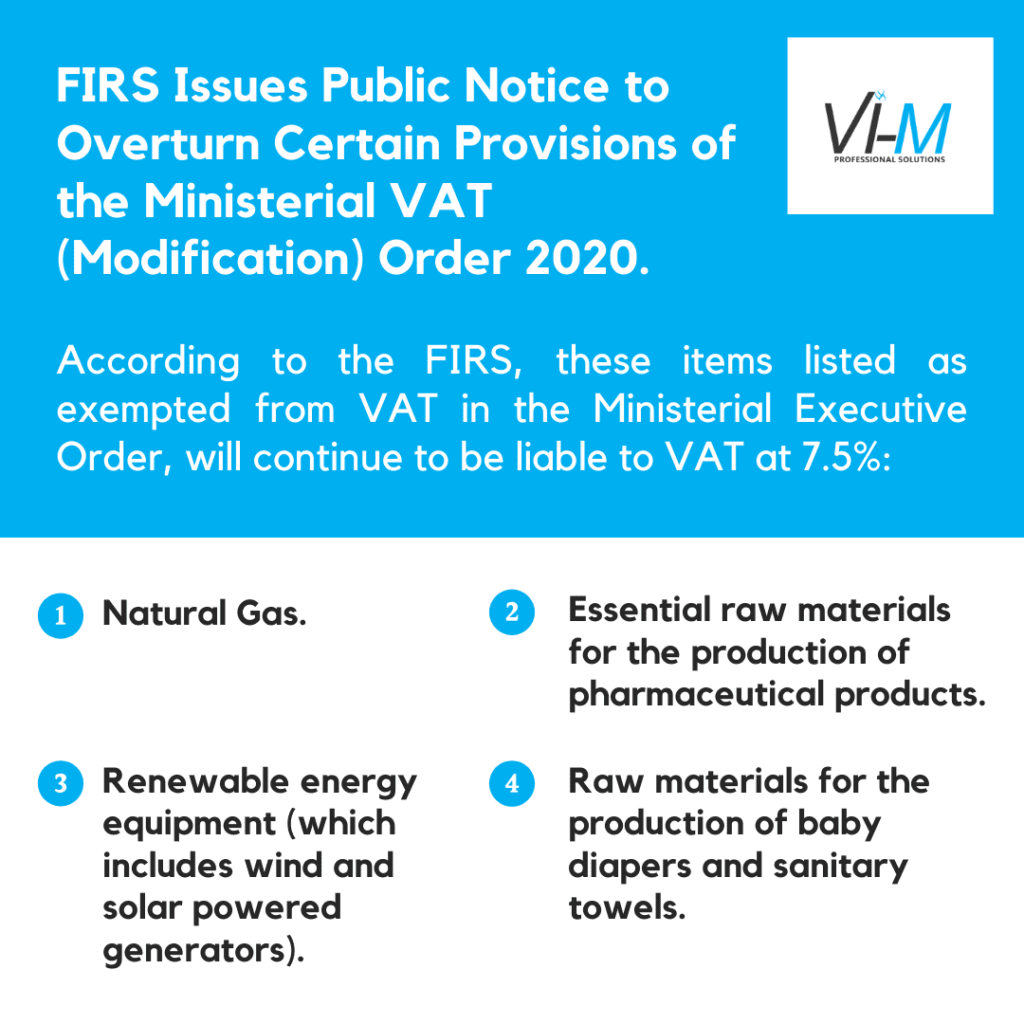
  • FIRS Issues Public Notice to Overturn Certain Provisions of the Ministerial VAT (Modification) Order 2020.

    On Wednesday, 24 June 2020, the Federal Inland Revenue Service (FIRS), issued Public Notices in the Newspapers, overturning the Value Added Tax (VAT) Exemptions granted to some items in the Value Added Tax (Modification) Order 2020, which was issued by the Minister of Finance, Budget and National Planning in May 2020.

    These items include:

    1. Natural Gas (which is a crucial component, required in most major sectors of Nigeria’s economy, e.g electricity generation, manufacturing, domestic use, fertiliser production, etc.)
    2. Essential raw materials for the production of pharmaceutical products.
    3. Renewable energy equipment (which majorly includes wind and solar powered generators).
    4. Raw materials for the production of baby diapers and sanitary towels.

    FIRS, in its Public Notice, argues that these items cannot be made VAT exempt by the VAT (Modification) Order as they were not listed on the 1st Schedule to the VAT Act, neither were they listed in a previous Ministerial Order.

    The FIRS insists that these items will continue to be liable to VAT at 7.5% until otherwise provided in an appropriate statutory instrument.

    Our views:

    First: The VAT (Modification) Order, 2020 firstly modifies the provisions of Schedule 1 of the VAT Act and then goes ahead to provide extended list/ interpretations for the all the items (as modified). FIRS’ argument on these items not being listed earlier in the VAT Act or in a previous Ministerial Order, may not therefore hold strongly.

    Second: Not all provisions of the VAT (Modification) Order 2020 are favourable to taxpayers or align with the earlier provisions of Schedule 1 to the VAT Act.e.g. the non-exemption given to basic food items sold in hotels, eateries and similar places and those supplied by caterers / contractors; baby products for children above 3 years old; and educational materials not used in conventional schools. Overturn to all these provisions therefore ought to be made uniformly, and not just to selected items.

    Third: The overturned exemptions relate to items that are essential goods for powering the major essential sectors of the economy. These items are continuously supplied in large quantities in Nigeria and their exemptions from VAT would cause a huge dip in tax revenues. In its endeavours to increase tax revenues collection, this may well be the major reason why FIRS overturns the VAT exemptions on these items.

    Fourth: Government should work towards harmonising all the divergent interpretations on such issues; for simplicity, ease and certainty of taxes in Nigeria, even as businesses and income earners struggle against the pandemic, the global economic decline and all other odds to protect their income and asset bases.

  • Going Digital Nigeria 4 – Webinar for Large Businesses

    We are pleased to invite you to episode four (4) of Vi-M Professional Solution’s Going Digital Nigeria free webinar series.

    Going Digital Nigeria is a 7-part (weekly) free webinar series on how to automate/ digitize practically all business processes in different industry sectors , to assist Nigerian businesses achieve effectiveness and growth during and post Covid-19. The Webinar series commenced on 3rd June 2020, has continued weekly, every Wednesday at 12.00 noon, and will run through 15 July 2020.
     
    Our topic for Wednesday, 24th June 2020 is “Going Digital Enterprise Businesses” (for large businesses generally and wholesalers with extensive supply chains).
     
    Our giant panelists include professionals who are authorities on the theme of the day. Details below:
     
    1.          Dr. (Mrs.) Titilayo Fowokan, Group Head, Strategic Tax & Compliance for Dangote Industries Limited
    2.         Emmanuel Obi, Business & Sales Manager for Oracle NetSuite
    3.         Daniel D’Souza, Senior Solution Consultant (PreSales) for Oracle NetSuite
     
    They will discuss how enterprise or large businesses & wholesalers with extensive supply chains are navigating the Covid-19 pandemic, the use/importance of technology and how digitalisation of processes has helped or will continue to help in the face of the pandemic and beyond.  
     
    Registration for this webinar & others in the series is still open at www.vi-m.com/webinars.
     
    All questions about the webinar should be directed to Vivian Chigozie-Nmonwu and / or Magnus Nmonwu via clients@vi-m.com / www.vi-m.com.

    Let us go digital Nigeria! – See you online on Wednesday by 12.00 noon.

  • The FIRS’ New Online Tax Clearance Certificate (TCC) Application Portal.

    The FIRS’ New Online Tax Clearance Certificate (TCC) Application Portal.

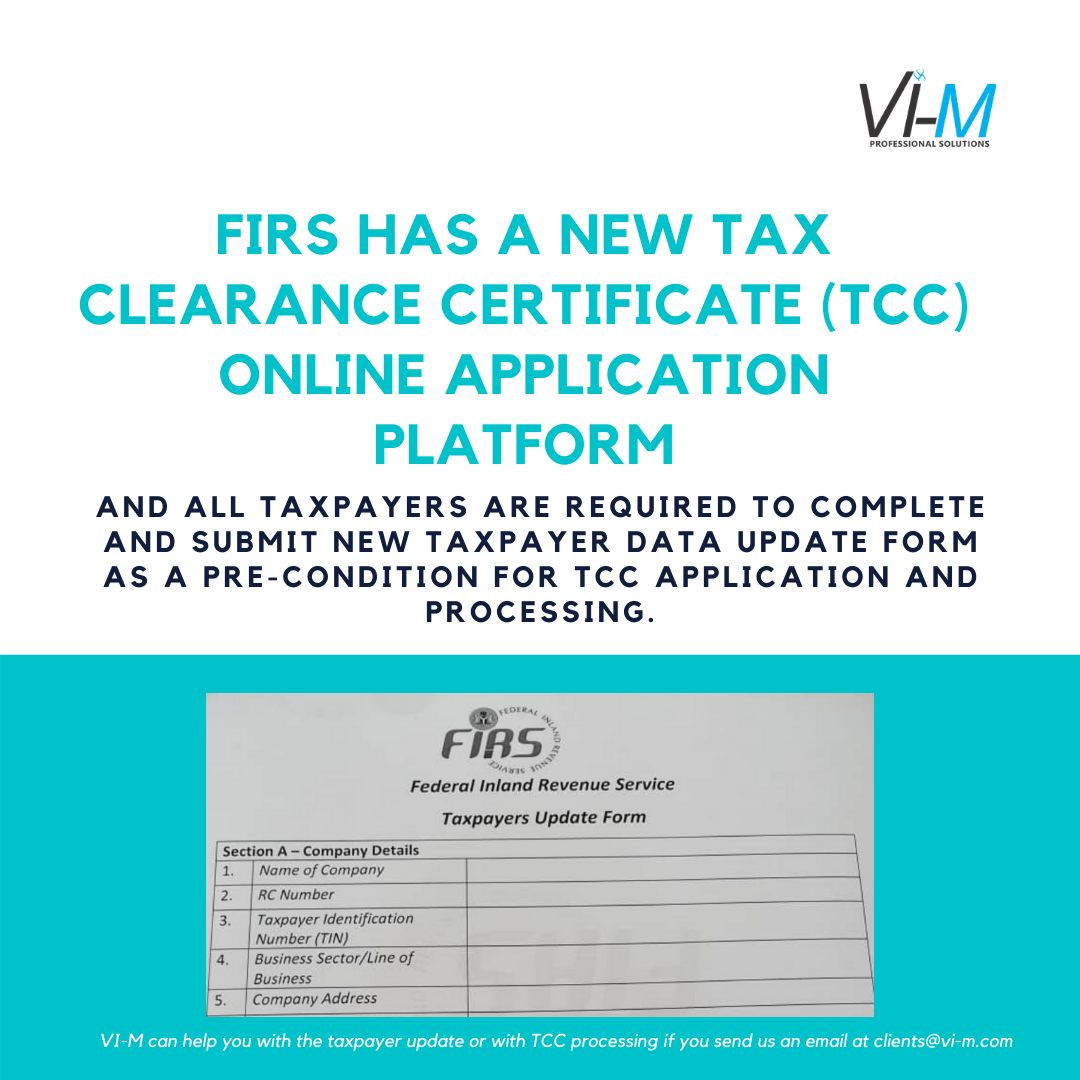
    The Federal Inland Revenue Service (FIRS) has recently migrated to a new online Tax Clearance Certificate (TCC) application portal.

    All taxpayers i.e. both those whose TCC applications are under processing under the old platform and those making new TCC applications under the new platform, are required to reapply/apply by submitting a taxpayer data update form. 

    Please find a copy of the taxpayer data update form here, print, complete, affix your company’s stamp and submit to your tax station.

    Please note that FIRS insists that taxpayers must submit this form as a pre-condition for getting a TCC .

    For taxpayers who require help with either the taxpayer data update or TCC application/ processing, please refer to our detailed ebook on ‘How to Get Tax Clearance Certificates in Nigeria’ – a step-by-step, self-help guide for all Nigeria taxpayers.

  • Going Digital Nigeria 3: Webinar for Nigerian Retailers

    We have successfully pulled off two very insightful sessions in our ‘Going Digital Nigeria‘ webinar series on how to automate / digitise practically all business processes in different industry sectors, to assist Nigerian businesses achieve effectiveness and growth during and post Covid19.

    Our third webinar in the series will hold on Wednesday, 17 June 2020, at 12.00pm (WAT)  on the theme, “GOING DIGITAL, RETAIL.

    If you are a retailer in Nigeria or interested in the retail business, this webinar is for you. How are you navigating the impact of Covid-19 on your retail business and making sure you come out bigger and stronger?

    We will be discussing tips for running a successful retail business and how to digitalize retail business processes and point of sale payments for effectiveness and growth during and post Covid-19.

    As always, our giant panelists will include:

    1.    Adedeji Faniyan, Head, Corporate Transformation at HealthPlus Limited, one of Nigeria’s largest retail chain stores. 

    Deji will be sharing his expert experience on how retailers are navigating the Covid-19 pandemic, business success tips for retailers and how digitization of processes can help retailers achieve effectiveness and growth during and post Covid-19 – with a case study of HealthPlus Limited.
     
    2.    Peter Magner, Sales and Marketing Director at Iridium Business Solutions, an accounting and business process automation firm in South Africa.

    Peter will be sharing his expert experiences on how the retail sector is navigating the pandemic and how digitization of retail business processes can help – a case study of Vend retail software, and then other retail point of sale (POS) software suitable for the average Nigerian retailer.

    3.    Inalegwu Alogwu, Group Head, Verve Digital, Interswitch Group, a leading financial technology payment processing company in Africa.

    Inalegwu will share expertise on how retail point of sale payment processing works, gadgets, tools involved, how merchants can set it up, advantages of automating the retail point of sale and payment process, and what Interswitch does generally in this regard. He will also enlighten Nigerian retailers on the ‘Integrated Till Solution’, what it means, how it works in Nigeria and its advantages to retailers.

    Registration for this webinar and our series can be done only at www.vi-m.com/webinars.

    All questions about the webinar should be directed to Vivian Chigozie-Nmonwu and / or Magnus Nmonwu via clients@vi-m.com / www.vi-m.com.

    Let us go digital Nigeria! – #RegisterNow!!!

  • Going Digital Nigeria! – Webinar Series 2

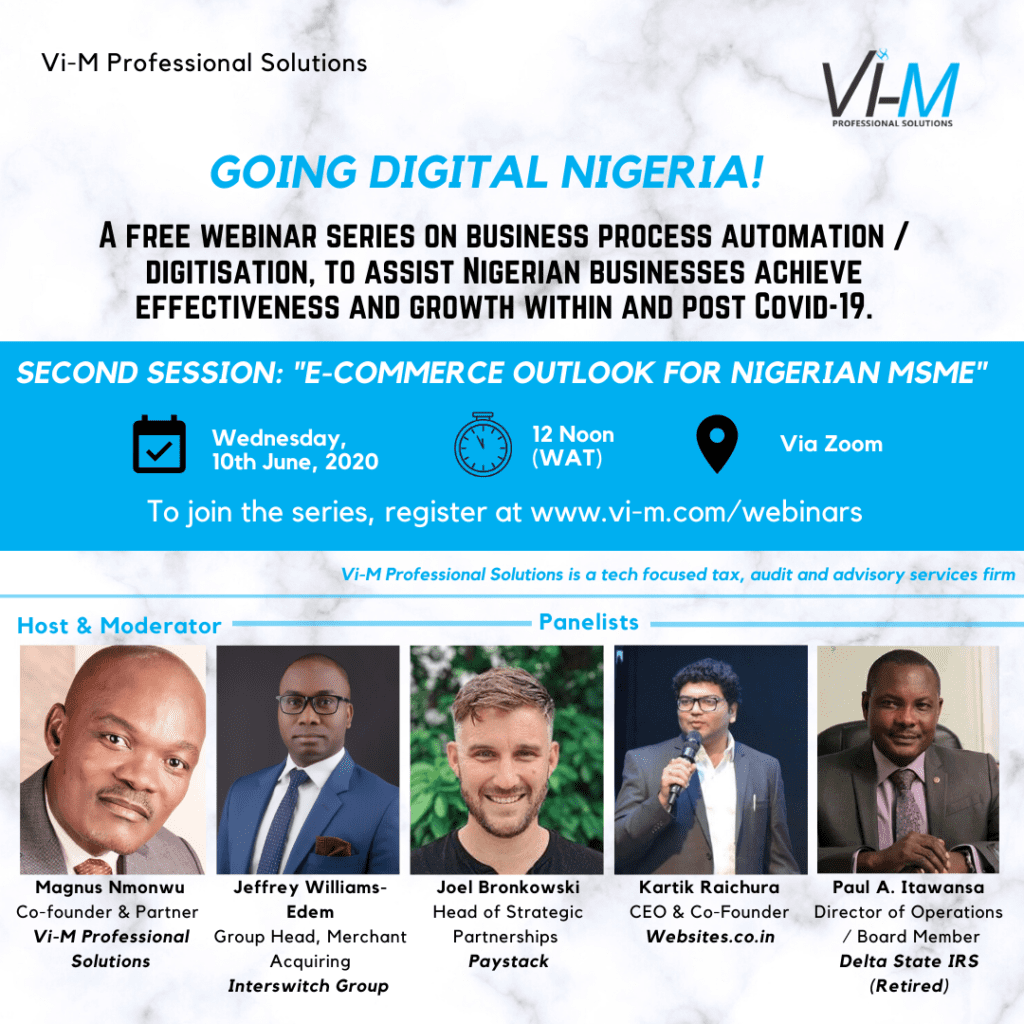
    Going Digital Nigeria, our 7-part (weekly) free webinar series on how to automate / digitise practically all business processes in different industry sectors, to assist Nigerian businesses achieve effectiveness and growth during and post Covid19 is in its 2nd edition!

    Our Panelists for the 10th June 2020 session will include the below mentioned people from notable organisations that have made global / far reaching impacts using technology tools (E-commerce). They include:

    1. Jeffrey Williams-Edem, Group Head, Merchant Acquiring for Interswitch Group. In his current role, he focuses on driving unique propositions that cater to the evolvement of merchant’s needs, customizing payment flows across selected industries. Also, focusing on technology advancement and operational efficiencies, while also designing, developing and growing the Interswitch Merchant Acquiring business across Africa.

    In this session, Jeff would explain what E-commerce entails, its role in the business life of an MSME, why and how MSMEs can easily adopt and utilize E-Commerce and highlight some of the various options available for MSME’s in Nigeria. He would also highlight available payment gateways in Nigeria that can easily be integrated to e-commerce platforms.

    2. Joel Bronkowski, Head of Strategic Partnerships at Paystack. Joel is one of a few people who have worked for both WooCommerce and Shopify on strategic and channel partnerships positions. At Paystack, he is saddled with the responsibility to tackle digital payments and E-Commerce in Africa. Joel is passionate about E-Commerce and strives to lower the entry barriers for small businesses to go digital.

    In his presentation, Joel would be sharing the tricks behind E-Commerce and payment platforms (explaining everything an MSME needs to know about E-Commerce), the advantages for MSME’s, why MSME’s need to take their business online, how to do this quickly and the benefits for MSMEs.

    3. Kartik Raichura, CEO and Co-founder of “Websites.co.in”. He is a serial entrepreneur, TEDx speaker and angel investor. He has been championing the digital movement for the world’s 200 million micro businesses specifically in areas of getting discovered, attracting new customers and growing bigger through automation led digital marketing.

    Having been recognized as a top 100 innovative leader by World Innovation congress and Top 50 marketing technology leaders by World Marketing Congress, he would be sharing a case study of “nothing to something”, highlighting how businesses unknown have become known and now global in outlook. He would re-echo the role of E-Commerce to MSME in the digital transformation and why it is important for businesses to go digital, especially at a period like this.

    4. Paul Akabrukeme Itawansa – former Director of Operations and Board member, of the Delta State Board of Internal Revenue – DBIR. Paul, a seasoned tax administrator with 32yrs of experience in all manners of taxation, would be giving us insights and tax implications for MSME’s Going digital.

    Registration for this webinar and our series can be done only at www.vi-m.com/webinars.

    All questions about the webinar should be directed to Vivian Chigozie-Nmonwu and / or Magnus Nmonwu via clients@vi-m.com / www.vi-m.com.

    Let us go digital Nigeria! – #RegisterNow!!!

  • FIRS Issues 3 Public Notices to Taxpayers.

    On 2 June, 2020, the Federal Inland Revenue Service (FIRS) issued 3 public notices to taxpayers.

    Here are the highlights:

    Public Notice 1: The FIRS is further extending the deadline for settling outstanding tax liabilities from self assessments, tax audits/investigations/ reviews and VAIDS from the earlier provided deadline of 31 May 2020, to 30 June 2020. FIRS, by this Public Notice, is asking taxpayers owing any such taxes to settle on or before 30 June 2020 in order to qualify for waivers of interest and penalty.

    Public Notice 2: The FIRS is asking all Nigerian and non-Nigerian businesses to keep proper accounting records in English language or risk penalties according to the tax laws.

    Public Notice 3: The FIRS is to resume activities relating to previously done tax audits, immediately. Field visits for tax audits/ investigation/ monitoring to resume on 30 June 2020.

    For further enquiries or help with your tax concerns, please contact us via clients@vi-m.com

  • Finance Minister Issues Executive Order on ‘Significant Economic Presence’ for Taxation of Non-Nigerian Companies

    The Federal Minister of Finance, Budget and National planning has recently issued “Companies Income Tax (Significant Economic Presence) Order, 2020′.

    The Order specifies what “Significant Economic Presence” means for the purpose of taxation of Non-Nigerian companies operating in the digital space in Nigeria in line with section 13(2)(c) of the Companies Income Tax Act (CITA) as amended by the Finance Act, 2019.

    It also specifies what “Significant Economic Presence” means for non-Nigerian companies carrying on trade or business comprising in provision of consultancy, management, professional and technical services in Nigeria in line with section 13(2)(e) of the Companies Income Tax Act (CITA) as amended by the Finance Act, 2019. 

    The Order is effective from 3rd February, 2020 and can be downloaded here.

    Highlights:

    1. Foreign owned/ controlled digital technology platforms/ tools that will qualify their non-Nigerian owners as having “Significant Economic Presence” (interpreted from the descriptions made by the Executive Order) for Companies Income Tax purposes in Nigeria would include: 

    a) Platforms selling digital products/ downloads, ecommerce platforms, social media platforms, mobile apps, web applications, app stores, accounting, payroll or ERP software providers, cloud platforms, data/ internet providers, freelance or job websites connecting suppliers with customers in Nigeria, eg. Fiverr.com, solutions such as Google solutions, video and music streaming platforms such as Netflix, YouTube, vimeo etc. as long as the aggregate earnings of those companies in Nigeria from one or combination of their digital solutions/ activities become more than N25 million in any accounting year.

    b) Non- Nigerian companies using ‘.ng’ domains or those that register their website addresses in Nigeria. There is no minimum turnover threshold attached to this condition but the provisions of CITA on ‘Small Companies’ would most reasonably apply.

    c) Digital platforms targeted to or has a purposeful or sustained interaction with Nigerian buyers, including presenting prices of their products and services in Naira or giving the option to buy in Naira. There is no minimum turnover threshold attached to this condition but the provisions of CITA on ‘Small Companies’ would also most reasonably apply.

    2. Non-Nigerian companies falling into the above 3 criteria will create a ‘Significant Economic Presence’ in Nigeria that would make them taxable under the provisions of the Companies Income Tax Act (CITA), just like other ‘Fixed bases’ and ‘Permanent Establishments’ of non-Nigerian companies. Rate of tax according to the provisions of CITA is either nil (for companies making N25million or less in annual gross turnover) or 20% or 30% based on turnover threshold in line with the Finance Act, 2019.

    3. Nigerian businesses using these digital solutions for their businesses would need to withhold tax from payments made to these foreign companies. Rate of withholding tax is not specified. However, it should be 5% when the transaction is treated like a general contract of supply, but given that digital technology is specialised, a more appropriate rate may be 10%.

    4. Some practical tax implications for Nigerian businesses using these digital platforms include:

    a) Most of these foreign companies are yet unaware of the changes in the Nigerian tax laws as it applies to them (even if they do, they may care less until strict measures are applied to them) and this means that they will not allow any withholding tax deductions from their payments. This will imply that Nigerian businesses may be mandated to bear the withholding tax burden on these transactions. 

    b).  Where withholding tax is borne by a Nigerian company on behalf of another person, this amount will also be taxable (for the Nigerian company) under CITA as it will NOT be allowed as a deductible business expense for tax purposes.

    c). App developers (businesses hosting apps on app stores) and partners (such as accounting software partners) may, by virtue of their agreements with the platform owners, be required to bear the tax applicable on the portion of the shared revenues attributable to the foreign platform owners. In this case, nos. (a) and (b) above would also apply to them.

    d). The practicable alternative for Nigerian businesses would be to ONLY use digital solutions offered by these non-resident companies for free.

    e). The second practicable alternative for Nigerian businesses is to buy off-the-shelf,  one-time-payment digital solutions.  

    f). Digital technology and platforms are being embraced by Nigerian businesses to make business easier and more effective. These new provisions and the practical tax implications places additional burdens which negates the purpose of embracing digital technology. 

    g). The ramifications of digital technology are so broad that neither the tax authorities nor the Nigerian businesses using these digital solutions can fully articulate them in order to determine the appropriate taxes that may apply. 

    h). Technology is a specialised field and lack of proper understanding of what it all entails may lead both taxpayers and tax authorities to making incorrect tax assessments and engaging in long drawn tax disputes eventually. 

    5. The second part of the Executive Order describes what “Significant Economic Presence” means for non-resident companies carrying on trade or business comprising in  provision of technical services (which includes training, advertising services or provision of personnel), consultancy, management and professional services in Nigeria.

    These non-Nigerian companies will be taxable at the rate of 10% (withholding tax), which will become the final Nigerian tax in the case of payments received for the aforementioned services: 

    i. From a Nigerian resident, or

    ii. From a fixed base of a non-Nigerian company 

    Payments relating to the following are excluded from creating “Significant Economic Presence”:
    a). Payments made to employees in an employment contract.
    b). Payments for these services made for teaching in or by educational institutions.
    c). Payments for such services made by the foreign fixed bases of Nigerian companies.

    6. In this regard,  Nigerian businesses (and fixed bases or agents of non-Nigerian companies) paying for these services would be required to withhold tax at 10% from the payments made to these foreign companies on these services. Such withholding tax would be the final Nigerian tax.


  • The VATrac (An Automated VAT Filing and Collection Platform) by the FIRS

    The VATrac (An Automated VAT Filing and Collection Platform) by the FIRS

    Earlier in the year, the Federal Inland Revenue Service (FIRS) issued a Public Notice to announce the coming into effect of the VATrac- An Automated VAT Filing and Collection platform which would be compulsorily used in the wholesale/ retail sector and for direct audit/ reconciliation of of VAT transactions.

    Affected businesses include branded shops, super stores, general supermarkets, standard restaurants; and eateries. These businesses are required to include in their transaction/ sales receipts the following:

    • FIRS or JTB TIN;
    • Print date;
    • Goods/ product description;
    • Receipt Number;
    • Grand total;
    • Standard 7.5% VAT rate

    VATrac was expected to have taken effect from 1 April 2020 and affected businesses have been asked to contact the nearest FIRS tax office for onboarding on VATrac. Further directives on the practical implementation/ use of the VATrac are however still being awaited from the FIRS .

    Businesses that would be affected by this new platform, namely, branded shops, super stores, general supermarkets, standard restaurants; and eateries are advised to prepare themselves for using an automated VAT system by staying abreast of retail related accounting software and automating their selling processes with a dependable Point of Sale (POS) software.

    Further, the VATrac by FIRS may also be a cloud based platform, necessitating the use of stable internet enabled devices for retail sales.

    For help with installing a retail/ restaurant/ eatery Point of Sale or accounting software, please contact us via clients@vi-m.com.

    To find out all about VAT and how it works in Nigeria, please refer to our ebook on ‘Value Added Tax Explained‘.