
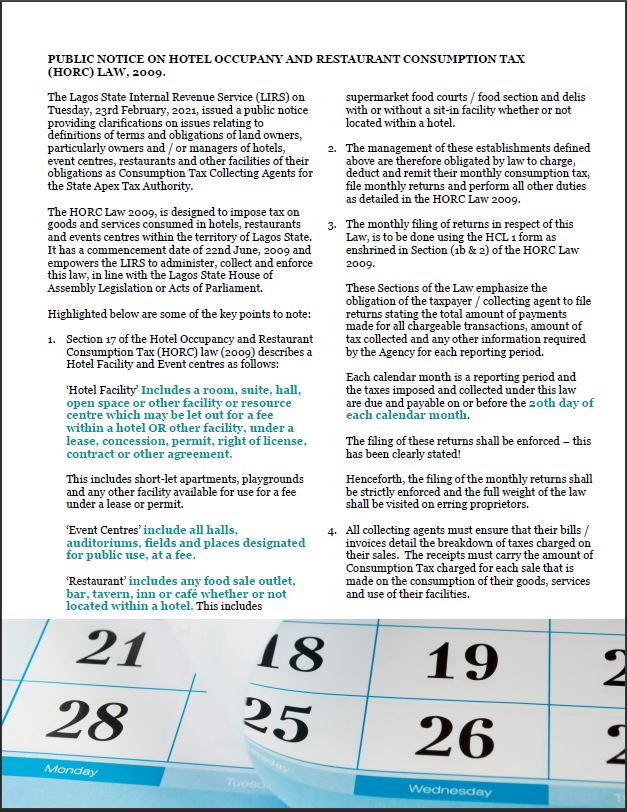
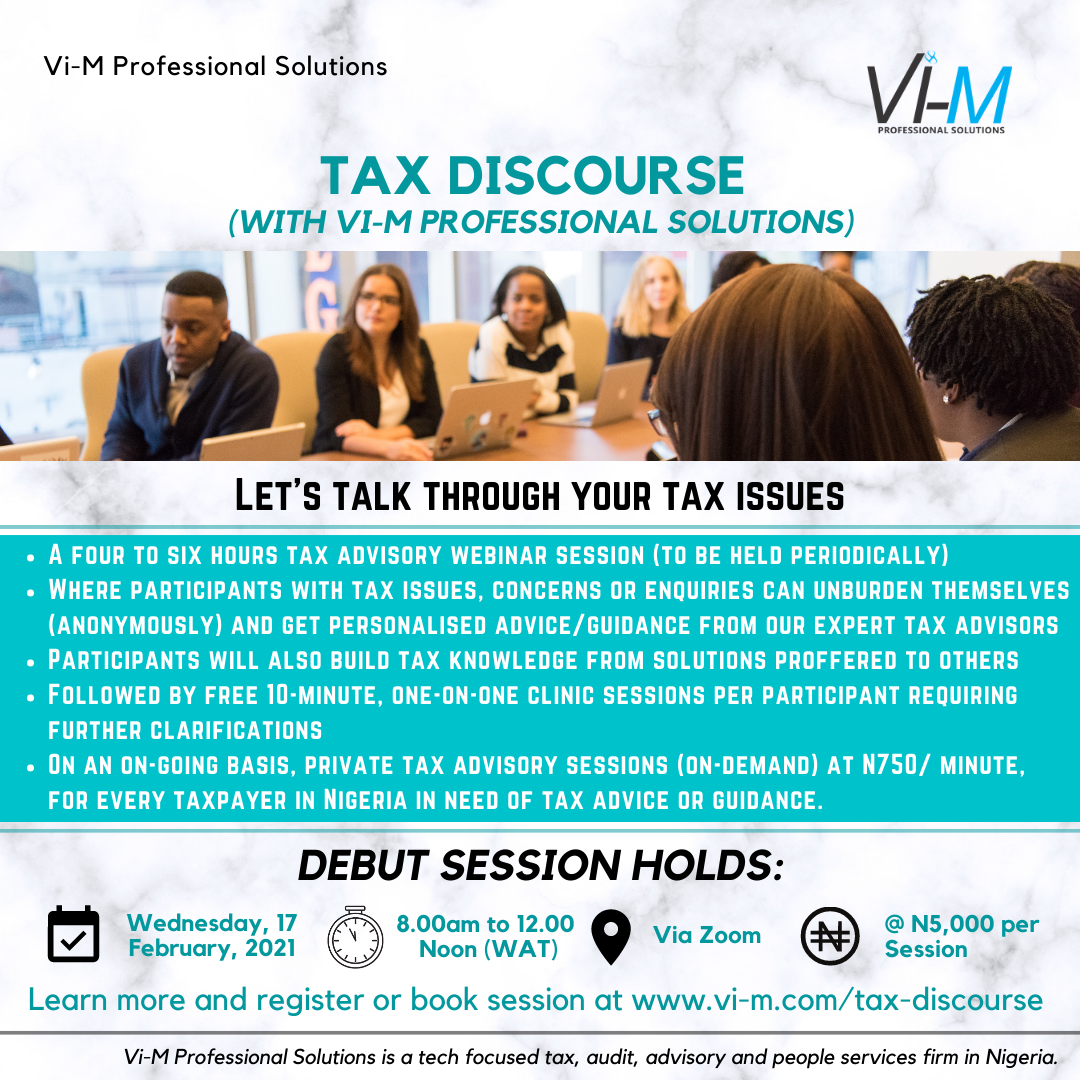
Vi-M’s debut session of ‘Tax Discourse Webinars’ is holding in 2 days, specifically on Wednesday, 17 February 2021.
Please register now if interested. We have only 14 slots still available.
Register now.
About Tax Discourse Webinars:
Learn more and book at https://www.vi-m.com/tax-discourse.
We look forward to you joining us on this debut webinar, and on an on-going basis!
For any enquiries or assistance, please send an email to clients@vi-m.com.
‘Tax Discourse’, with Vi-M Professional Solutions is a platform through which we make personalised and professional tax advisory accessible and very affordable to every Nigerian taxpayer; an initiative, which will enable us support the everyday Nigerian taxpayer with strategic insights and knowledge (on an one-going basis) on how to better navigate any tax challenge.
The video clip below presents the different perspectives to how Tax Discourse can help taxpayers in Nigeria with on-the-go, easy, accessible, professional and expert tax advisory/ guidance through their tax concerns:
‘Tax Discourse’, with Vi-M Professional Solutions is offered in 2 ways :
‘Tax Discourse Webinars’ and ‘Tax Discourse (On-Demand)’.
The Debut session of Tax Discourse Webinars will hold on Wednesday, 17 February. 2021, from 8.00am to 12.00 noon.
About Tax Discourse Webinars:
Learn more about Tax Discourse and book for any of the sessions at www.vi-m.com/tax-discourse.
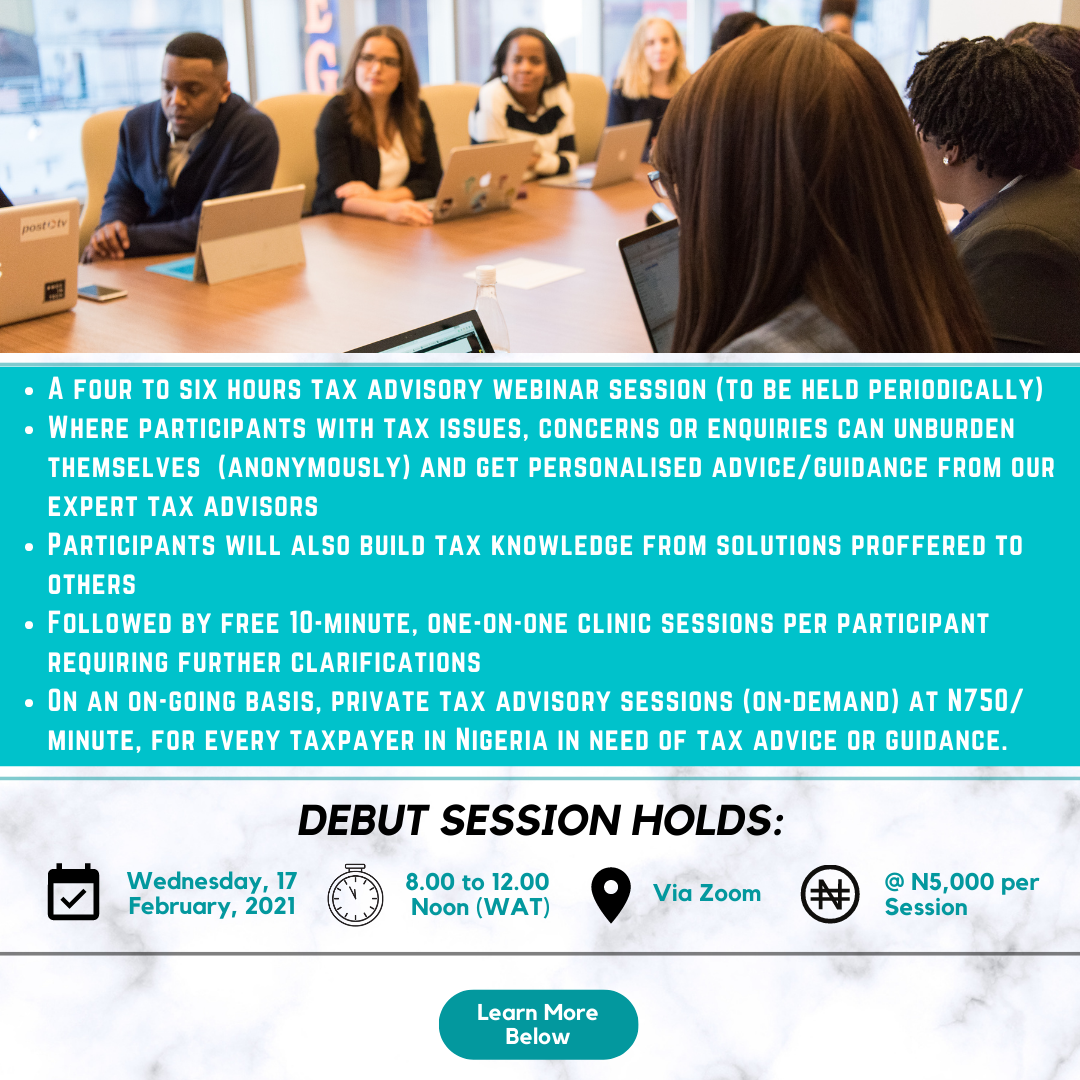
Back in 2015, our firm, Vi-M Professional Solutions, was engaged by the Federal Inland Revenue Service (FIRS) to help Nigerian taxpayers understand tax through weekly tax technical publications in the Guardian Newspapers themed ‘Tax Discourse’.
Tax Discourse (with the FIRS) was a platform designed to enable Nigerian taxpayers and the FIRS share knowledge and pain points about tax and better understand each other. It ended in 2016.
On this first day of the brand new month of February 2021 however, we are very happy to let you know about our brand new initiative:
‘Tax Discourse’, with Vi-M Professional Solutions (solely run by Vi-M, this time).
Tax discourse is a platform through which we, at Vi-M Professional Solutions, can make personalised and professional tax advisory accessible and very affordable to every Nigerian taxpayer.
An initiative, which we hope will enable us support the everyday Nigerian taxpayer with strategic insights and knowledge (on an one-going basis) on how to better navigate any tax challenge.
‘Tax Discourse’, with Vi-M Professional Solutions is offered in 2 ways:
First is ‘Tax Discourse Webinars’:
And the second is ‘Tax Discourse (On-Demand)’:
Who is ‘Tax Discourse’ for?
Everyday business people who are interested in how tax will impact their businesses and business incomes;
Everyday business people and income earners who do not like tax and are looking for legitimate ways to avoid taxes;
Businesses undergoing tax audits and seeking strategies or approaches to legitimately and favorably navigate the audit;
Taxpayers who might be getting a bit confused about what taxes (or tax exemptions) that will now apply to them or their businesses, with all the changes in tax laws in 2020 and now in 2021;
Start up businesses that need to know all what they are required to do with regards to tax;
Businesses earning less than N25 million in annual gross turnover, seeking to learn the extent of tax exemptions granted to them;
Non-residents doing business in Nigeria and seeking to know how taxes may apply to their operations, business dealings and /or permanent establishments;
Non-residents seeking to know what constitutes significant economic presence or otherwise, for the purpose of the business they do in Nigeria or their digital platforms used by Nigerians;
Tax practitioners or finance professionals who need peer reviews or discourse on tax issues;
Employees seeking to know exactly what taxes their employers are allowed to deduct from their pay and how employers are meant to account for such deductions for the their benefits;
Accounting or ERP systems experts or the businesses implementing accounting or ERP systems, who would you like to get professional guidance on how to set up taxes on their accounting or ERP software/ systems;
Businesses, accountants and auditors needing help with tax accounting and disclosures for their financial statements;
And every other tax stakeholder who needs someone to speak to about anything Nigerian taxes!
Learn more about ‘Tax Discourse’ and book for any of the sessions on https://www.vi-m.com/tax-discourse.
We look forward to you joining us on this debut webinar, and on an on-going basis!
For any enquiries or assistance, please send an email to clients@vi-m.com.
.
.

.

Earlier today, 20 January 2021, our firm, Vi-M Professional Solutions hosted a webinar on the theme, “The Finance Act 2020 and Nigerian Taxpayers”.
At the webinar, our partners, Vivian Chigozie-Nmonwu and Magnus Nmonwu reviewed the changes in tax laws and practice by the newly signed Finance Act 2020, which became effective in Nigeria on 1 January, 2021; and the impact on Nigerian taxpayers (including non-residents).
Please find below a recording of the webinar, for your replay and viewing pleasure:
For more enquires or comments on the Finance Act 2020, or other tax related topics, please do not hesitate to contact us via email: clients@vi-m.com.

The Personal Income Tax Act (PITA), is the basis for calculating, deducting and remitting the monthly employee taxes and direct assessment for individuals in Nigeria.
The PITA requires all employers to file a return with the Relevant Tax Authority (RTA) of all emoluments paid to its employees, not later than 31st January of every year – this is called the Employers Annual Declaration and Certificate (Form H1) and Employers Remittance Card (Form G). Failure to file these returns within the stipulated time attracts a penalty of N500,000 for companies and N50,000 for individuals.
Furthermore, every taxable person is required to file with the RTA a return within 90 days from the commencement of every year of assessment (31st March) – this is called Income Tax Form for Return of Income and Claims for Allowances and Reliefs (Form A). There is no penalty for failure to file this return.
Based on the provisions of this Act, all employers (for persons in employment) and the taxable persons are saddled with the responsibility to prepare and file these returns within the stipulated time in the states where the respective employees reside or where the taxable person is resident.
It is a known fact that there are numerous Payroll and Human Resources software aimed at assisting employers calculate and determine the taxes on employee earnings. However, we still see a number of companies failing to meet these deadlines. Even when they do, it is our experience that the returns are not accurate and as such leads to a lengthy tax audit exercise when the RTA comes knocking at your offices.
Filing of these returns are mandatory and not voluntary. The RTA is not obliged to issue a notice or demand to render these annual returns. It is therefore expedient that these returns are rendered timely and accurately.
The season to render these returns is upon us. It is time to balance your accounts, remit and file your returns to the RTA before the respective deadlines (31st January 2021 for Forms H1 & G and 31st March 2021 for Forms A). A template of these forms can be obtained from your respective tax stations of tax officers.
Below are some tips on how to go about ensuring that you meet the deadlines and that your returns are accurate, so as to avoid penalty and interest charges arising for inaccurate returns:
In conclusion, it pays for every employer, company or individual to file their returns promptly. It affords you the freedom to concentrate on your core business operations as you would have discharged one of your annual responsibilities to the state.
Finally, section 45 of PITA, grants a bonus of 1 percent of the tax payable to a person (employers or individuals) who files his/her returns early. Why not seek to take advantage of this and file your returns early!
The analysis, views or information expressed above are our interpretation of the applicable laws and general practices of RTA’s. This article is also expected to provide a general guide to the reading public on the subject matter. Therefore, you should engage a professional services firm (www.vi-m.com) to review your specific circumstance and provide you a more detailed and tailored opinion as it affects your business operations or person.

Happy new year Nigeria!!! Happy new year world!!!
We do hope you had that well deserved rest this holiday season after all the challenges of the year 2020.
We are reopening for the business year today and this is us, being thankful still, for this relationship with you.
We wish you a very happy, healthy, blessed and prosperous new year, 2021. May the new year favour us all in the most important areas of our lives. Amen.
Here are some things that have fallen due in Nigeria’s business terrain. You should know about them in order to position your self/ business to navigate or take advantage of them this new year:
The #OneAfricanMarket of the African Continental Free Trade Area (AfCFTA) has been launched in earnest and has commenced trading since 1 January 2021. Opportunities abound for easy trade and low or no custom tariffs among 1.2 billion Africans in all African countries. For more information, visit www.afcfta.au.int.
This ebook prepared by the African Union and other partners will also help you understand what the AfCFTA is all about in simple language.
Secondly, Nigeria’s Finance Act 2020, the second in 2 years (after the Finance Act 2019) has been signed into law alongside Nigeria’s N13.588 trillion ‘Budget of Economic Recovery and Resilience’, on 31 December 2020, by President Muhammad Buhari.
Both the Finance Act 2020 and the Budget, also became effective on 1 January 2021. We had originally compiled the highlights of the first draft of the Bill here – although several of the proposals did not make it to the signed version of the bill, while many other new provisions were included and some other tax laws amended. We have also compiled most of the important things you need to know about the newly signed Finance Act 2020 in the video below:
We will look out for any further changes once the law is published in a gazette and notify you accordingly.
Thirdly, this is the time for filing your yearly employer tax returns.
On or before 31 January every year, all enterprises, companies or incorporated trustees in Nigeria are expected to voluntarily file their annual returns under the Personal Income Tax Act (PITA) Cap P8 LFN 2004 (as amended). Failure to file these returns within the stipulated time attracts a penalty of NGN500,000 for companies and NGN50,000 for individuals.
The LIRS’ e-filing platform for filing of annual returns can be accessed via www.etax.lirs.net. Once the webpage opens, the user should login and follow the self-explanatory prompts until the returns are uploaded and submitted. Please note that the user would need his or her organisation’s RC/BN/IT number or LIRS issued taxpayer ID, to login or register on the platform.
The platform basically requests for upload of information (using the templates provided) on the following:
For further guidance on how to use the e-filing platform, please click here.
For help with filing your employer tax returns, please send an email to clients@vi-m.com.
Our post on 2020 EMPLOYER ANNUAL RETURNS – ARE YOU READY? explains a lot of things you need to know about filing your annual employer and taxpayer returns.
We wish you a happy and prosperous new year once again!

A year of pandemic;
A year of fears;
A year of many deaths;
A year of lock-downs;
A year of webinars;
A year of business failures;
A year of business opportunities;
A year of many set backs;
A year of #EndSARS;
A year of grace;
A year of new dawns.
Here at Vi-M, not all we set out to do were achieved, but we are very grateful for all the ones we could achieve:
1. Partnership with over 9 accounting, ERP and payroll software companies for end to end financial process automation and accounting system setup for businesses of all types and sizes. Several businesses assisted to set up their accounting, ERP and Payroll systems.
2. Revamping and republishing of our Tax Law Book App on Google and IOS stores with all the tax laws as amended to date (including the Finance Act), and many more resources.
3. Our ‘Going Digital Nigeria’ 7-part webinar series which brought together leaders of industries and thought leaders in a first-of-its-kind, remarkable business process automation insight series that impacted many businesses in different industries.
4. Our webinar on ‘Stamp Duty as it Impacts Nigeria’s Real Estate Sector’ – well attended by Nigerian landlords, property owners, agents, tenants, real estate business men and women, real estate investors, speculators, consultants, developers, lawyers, workers, insurers, bankers etc.
5. Our online training courses that ran every other day for four months, between August 2020 to November 2020.
6. Several small companies assisted, to file CIT tax returns and claim tax exemptions in line with the Finance Act 2019.
7. Several businesses assisted, to put together adequate documentations for loan applications.
8. Partnership with ACCION Microfinance Bank to mentor their MSMEs on how to sustain business operations and thrive during and post the pandemic.
9. Launch of our Easy-Work initiative on www.vi-mtalentassist.com – a commission based flexible work arrangement to cushion the adverse effects of the pandemic on jobs.
10. Job placements, training, youth empowerment and entrepreneur story showcase on www.vi-mtalentassist.com.
11. Engagement by the Federal Government on an important tax related assignment.
12. Engagement by a multinational telecommunications company as a supplier of audit and assurance services.
13. Partnership with a notable trade/ business association in Nigeria to automate their members’ business processes/ setup their accounting systems.
14. Launch of ‘Together We Thrive’ webinar series, helping numerous businesses on various training topics, at the MSME Crowd Funding Foundation (www.fundanenterprise.org).
15. Mentorship on fundraising, finance and business process improvement for many businesses, all year round, at the MSME Crowd Funding Foundation.
For the opportunities, strength, insights, innovation, remarkable teamwork and partnerships that work, which enabled us accomplish all of these, we are extremely grateful to God.
Thank you for being part of our success story, from inception of our firm till now, even through the unprecedented chaos of 2020.
We wish you a happy holiday this end of year, and a hope filled 2021.
As promised by President Buhari’s administration – to issue a Finance Act annually to accompany the nation’s budget, the 2020 Finance Bill is already drawn up and undergoing stakeholder reviews and approval processes.
The draft Finance Bill is set to amend the following legislations:
Click the image below to view/ download our ebook containing details of the proposals for the Finance Bill 2020.
The Finance Act 2019 (a landmark legislation issued 20 years after the Finance (Miscellaneous Taxation Provisions) Decree/ Act in 1999) made sweeping changes to Seven of Nigeria’s most significant tax laws. And true to the promise made by the President Buhari administration – to issue a Finance Act annually to accompany the nation’s budget, the draft of the 2020 Finance Bill is already drawn up and currently at its exposure phase with stakeholders.
According to President Buhari, in his 2021 budget presentation speech to the Parliament, the Finance Bill 2020 is to support the realisation of Nigeria’s 2021 revenue projections, adopt appropriate counter-cyclical fiscal policies and enhance the efficiency of fiscal incentives.
In the full week of 9 November 2020 to 13 November 2020, there were continuous focused stakeholder engagements by the Fiscal Reforms Committee – the Federal Government constituted committee tasked with development of Nigeria’s annual Finance Bills. This culminated in a public stakeholder consultation / engagement webinar on Friday, 13 November 2020, hosted by the Minister for Finance in support of the Fiscal Reforms Committee.
All interested stakeholders in the Nigerian tax system are by this engagement, being called upon to make suggestions as to tax law reforms or additions to be considered for inclusion in the Finance Bill 2020.
The Finance Bill 2020 is staged across five (5) broad thematic areas as follows:
All stakeholders who wish to make recommendations for inclusion in the Finance Bill 2020 are called upon to submit such views, comments and suggestions to the Committee through the email address – socialmedia@finance.gov.ng, on or before Monday, 16 November 2020.
All stakeholder views will be collated, reviewed and updated accordingly in the draft bill (click to view first draft). The Bill would be submitted to the Federal Executive Council for approval and then handed over to the President for presentation to the Parliament.