Blog

  • An Overview of the Petroleum Industry Act, 2021

    An Overview of the Petroleum Industry Act, 2021

    Introduction

    The Petroleum Industry Act was signed into law by President Muhammadu Buhari on Monday, August 16, 2021 after series of amendments and dialogues which spanned about 20 years from the time it was first introduced. The Act provides legal, governance, regulatory and fiscal framework for the Nigerian petroleum industry as well as the development of host communities.

    Overview
    • Establishment of the Nigerian Upstream Regulatory Commission

    The Commission is saddled with the responsibility of regulating technical, operational and commercial activities in the upstream petroleum sector; monitor compliance with rules regulating the sector; enforce compliance with the terms and conditions of leases, licences, permits and authorisations granted to companies in the upstream petroleum sector; establish and enforce standards relating to upstream petroleum activities and undertake evaluation of national reserves while developing policies for prudent reservoir management practices.

    Furthermore, the Commission is mandated to keep public registers detailing beneficial ownership of leases, licences, permits and authorisations issued by it. It is also to develop, maintain and publish a database of upstream petroleum and advise the Minister of Petroleum on all matters relating to upstream petroleum activities.

    • Establishment of the Nigerian Midstream and Downstream Regulatory Authority

    This body is responsible for the technical and commercial regulation of midstream and downstream petroleum operations. This involves ensuring efficient and effective infrastructural development, compliance with regulations, implementation of government policies, development of a framework on tariff and pricing, amongst others.

    • The Nigerian National Petroleum Company Limited

    Part V, Chapter 1 of the Act provides for the administration of the Nigerian National Petroleum Company (NNPC) Limited which is to be incorporated with the Corporate Affairs Commission within 6 (six) months of the commencement of the Act with the Ministry of Finance and Ministry of Petroleum Incorporated as shareholders. The assets, interests and liabilities of NNPC are to be transferred to NNPC Ltd or its subsidiaries within 18 months of commencement of the Act after which NNPC shall cease to exist.

    • Establishment of Incorporated Joint Venture Companies

    The Act permits NNPC Ltd and parties with joint operating agreements in the upstream petroleum sector to voluntarily incorporate joint venture limited liability companies subject to the provisions of the Second Schedule to the Act.

    • Introduction of New Licences and Lease for Upstream Operations

    The Act introduces the following licences and lease:

    1. Petroleum exploration licence to carry out petroleum exploration on a non-exclusive basis
    2. Petroleum prospecting licence to carry out petroleum exploration on a non-exclusive basis and drill wells, do corresponding test production on an exclusive basis
    3. Petroleum mining lease to carry out petroleum exploration on a non-exclusive basis; drill wells, carry out test production, win, work and dispose of crude oil, condensates and natural gas on an exclusive basis.

    In the same vein, the Act further restricts the duration of a petroleum prospecting licence for onshore and shallow water acreages to 6 (six) years while that of deep offshore and frontier acreages is limited to 10 (ten) years. The duration for a petroleum mining lease is a maximum of 20 years and it may be extended for further terms of not more than 20 years per renewal.

    • Provision for Host Communities Development

    In order to allay the longstanding grievances of host communities, the Act dedicates Chapter 3 to their development. It provides for the incorporation of a host communities development trust [section 235(1)] to manage and supervise the administration of the annual contribution of holders of a lease or licence (settlor). A settlor is mandated to contribute 3% of its actual annual operating expenditure of the preceding financial year in the upstream petroleum operations to the fund.

    • Provision for Payment of Hydrocarbon Tax (HT) and Companies Income Tax (CIT)

    The Act is clear that companies engaged in petroleum operations whether upstream, midstream or downstream are to be subject to companies’ income tax at the rates provided under CITA. In addition to the CIT, companies in the upstream petroleum sector are chargeable to hydrocarbon tax which applies to crude oil, field condensates, liquid natural gas derived from associated gas and produced in the upstream field. However, it is important to note that HT does not apply to deep offshore as well as natural gas operations.

    HT is payable at the rate of 15% of profit from crude oil for onshore and shallow water and for petroleum prospecting licences (PPL) while the rate is 30% of the profit from crude oil for petroleum mining leases (PML) with respect to onshore and shallow water areas.

    Also, allowable expenses for the purposes of calculating HT must be directly related to the production operations. The non-direct costs will, however, be deductible under CIT.

    • Requirement for the Separation of Upstream, Midstream and Downstream Operations

    For tax purposes, the Act requires that a company intending to be involved in more than one stream of petroleum operation should register a separate company for each. It further provides an option for the establishment of an Integrated Strategic Project (ISP) for companies in the upstream petroleum sector which seek to produce oil or gas and refine it for wholesale supply subject to the provisions of section 302(4) of the Act.

    • Other Fiscal Provisions

    Companies engaged in midstream petroleum operations, downstream gas operations, large scale gas utilisation as well as investors in gas pipelines are entitled to incentives under section 39 of CITA which include a tax-free period of 3 years and accelerated capital allowance after the tax-free period among others.

    Natural gas transferred from the upstream to the midstream or downstream as well as natural gas liquids and liquid petroleum gases are chargeable to tax under CITA.

    Section 302(9) provides that “acquisition costs of petroleum rights shall be eligible for annual allowance at the rate of 20% with a retention value of 1% in the last year until the asset is disposed.”

    CONCLUSION

    The enactment of the Petroleum Industry Act is a welcome development in the country’s legal and regulatory space especially with respect to the petroleum industry which is the mainstay of our economy. While it is hoped that the provisions of the Act will bring about growth in the petroleum sector, it is recommended that the government should begin to shift its focus towards transitioning to clean energy for the purpose of sustainable development.


  • Rivers State, FIRS and Value Added Tax (VAT)

    Rivers State, FIRS and Value Added Tax (VAT)

    On 9 August 2021, the Federal High Court, Port Harcourt division, issued a very controversial ruling on Value Added Tax (VAT). In a case of the Attorney General of Rivers State vs Federal Inland Revenue Service (FIRS) and Attorney General of the Federation (Suit no. FHC/PH/CS/149/2020), the Court declared the VAT Act unconstitutional and transferred the power to collect VAT in Rivers State from the FIRS to Rivers State.

    The FIRS has since appealed this ruling at a higher court, while insisting that taxpayers in Rivers State should continue to pay VAT to the FIRS.

    In the meantime, Rivers State has, on 19 August 2021, signed into law, the Rivers State Value Added Tax Act which provides for the imposition and administration of VAT in Rivers State. The Rivers State VAT law imposes VAT at 7.5% on the supply of taxable goods and services except those exempted under the schedule to the Law.

    The Rivers State Internal Revenue Service (RSIRS) is empowered by the law to administer, implement, assess, collect and account for money collected.

    Other important provisions of the Rivers State VAT Act includes:

    • A taxable person under the law is required to register with the Board within 6 months of the commencement of the Law or 6 months of commencement of business, whichever is earlier.
    • Registration for VAT under the law is a condition for obtaining a contract from a government ministry, agency or statutory body.
    • A non-resident company that carries on business within the State is to register for the tax with the Board, using the address of the person with whom it has a subsisting contract. The non-resident company is to include the tax in its invoice while remittance is to be made by the person to whom the goods or services are supplied in the State, in the currency of the transaction.
    • Refusal to register for the tax within the time specified is a punishable offence.
    • The law mandates payment of the tax on taxable imported goods before they are cleared.
    • Where a person disagrees with the amount assessed, he may object to the RSIRS.
    • Tax is to be remitted on or before the 21st day of the following month.
    • There is no exemption for small and medium enterprises with turnover of less than N25 million.
    • The State government shall receive 70% of the revenues from the tax, while 30% would go to the local governments.
    • The Schedule to the law exempts the following goods and services from VAT:

    i. All medical and pharmaceutical products

    ii. Basic food items

    iii. Books and educational materials

    iv. Baby products

    v. Fertilizers, locally produced agricultural and veterinary medicine, farming machinery and farming transportation equipment.

    vi. All exports

    vii. Plant, machinery and equipment purchased for the utilisation of gas in the downstream petroleum operations.

    viii. Tractors, ploughs and agricultural equipment and implements purchased for agricultural purposes.

    ix. Medical services.

    x. Services rendered by the community banks, Microfinance banks and mortgage institutions.

    xi. Plays and performances conducted by educational institutions as part of learning.

    xii. All exported services.

    As of 20 August 2021, Rivers State government had, further to issuing the new VAT law, begun issuing official demand letters to businesses operating in Rivers State, demanding that they remit all VAT due, for August 2021, to the designated Rivers State VAT collection account.

    As it is, taxpayers in Rivers State are caught in dilemma between the two Regulators. No one knows for sure the ultimate verdict until the case is ruled by the Supreme Court. In the meantime, failure to file / remit VAT returns to any of the two authorities may result in two-fold accrual of penalties and interest for Rivers State taxpayers, since the Federal VAT law is still effective and has not been cancelled or revoked by any legislative action.

    Affected taxpayers may find that a very strategic way to mitigate VAT risks in this controversial circumstance may be to commence filing NIL tax returns to both tax authorities until the issue is resolved by the Supreme Court or by the Federal Law makers.

  • Tax Filing Deadline

    Tax Filing Deadline

    Wednesday, 30 June 2021, is the deadline for Nigerian companies with financial year end of 31 December 2020 to file their income tax returns. 

    Such companies are expected to:

    1. Prepare their companies’ income tax computations.

    2. Prepare audited financial statements (companies making annual gross turnover of N100m or less, may not be required to audit the financial statements – draft accounts may be accepted).

    3. Apply for taxpayer update on Federal Inland Revenue Service (FIRS)’ e-filing portal (if not done already) – to allow the company access to e-filing and other FIRS’ e-services.

    4. File companies’ income tax returns and the accompanying financial statements via the FIRS’ online TaxPro MAX platform before 30 June 2021.

    5. Make tax payment with the ‘Document Identity Number’ (DIN) generated from the TaxPro MAX platform on or before the same deadline date.

    For companies making annual gross turnover of N25m or less, they will not be required to pay companies income tax as long as they complete their income tax filing before this deadline (they are required to file income tax returns but exempted from paying the tax).

    We (Vi-M Professional Solutions) can assist any Nigerian company get the income tax filing done or assist with navigating the FIRS’ digital platform, but please contact us as soon as possible as the deadline is just few weeks away.

    Email clients@vi-m.com, call or chat with us on WhatsApp number +234 810 793 0666 to get started.

    *Please also note that following the recently signed Institute of Chartered Accountants of Nigeria (ICAN)/ Association of National Accountants of Nigeria (ANAN) vs Chartered Institute of Taxation of Nigeria (CITN) Memorandum of Understanding, only CITN members with valid Practicing Licences can help clients file tax returns for a fee, with effect from 1 August 2021. On this backdrop, all companies / businesses are advised to please enquire from their tax consultants about their CITN issued practicing licences.

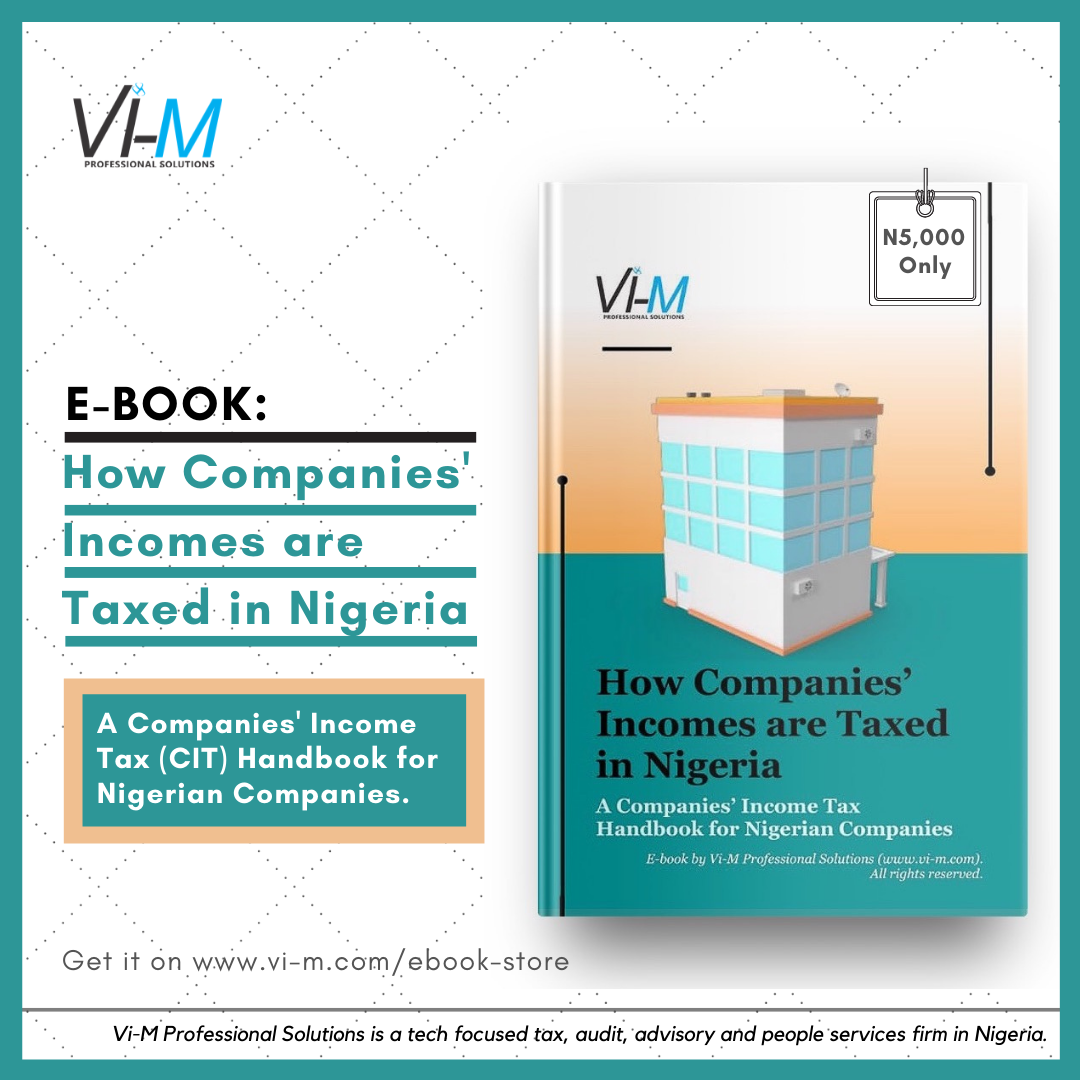
    For those who may want to ‘do it themselves’, our ebook on ‘How Companies’ Incomes are Taxed in Nigeria‘, provides  the necessary technical guidance.

    This ebook can be purchased and downloaded from www.vi-m.com/ebook-store.

  • Introducing our Ebooks on Various Practical Tax Topics

    We are happy to introduce to you, our ebooks on various practical tax topics/ issues.

    The topics are handpicked based on everyday tax issues encountered by Nigerian taxpayers, carefully and comprehensively written (captures all amendments to the tax law to date, i.e up to the Finance Act 2020, which became effective from 1 January 2021), in an easy, everyday language to aid understanding by the everyday Nigerian taxpayer. This is our own little way of making this complicated tax subject simple!

    We do hope that they become the much needed reliable and formidable tax guides for the everyday Nigerian taxpayer.

    You can get them all on www.vi-m.com/ebook-store

    The topics currently available on our ebook store include:

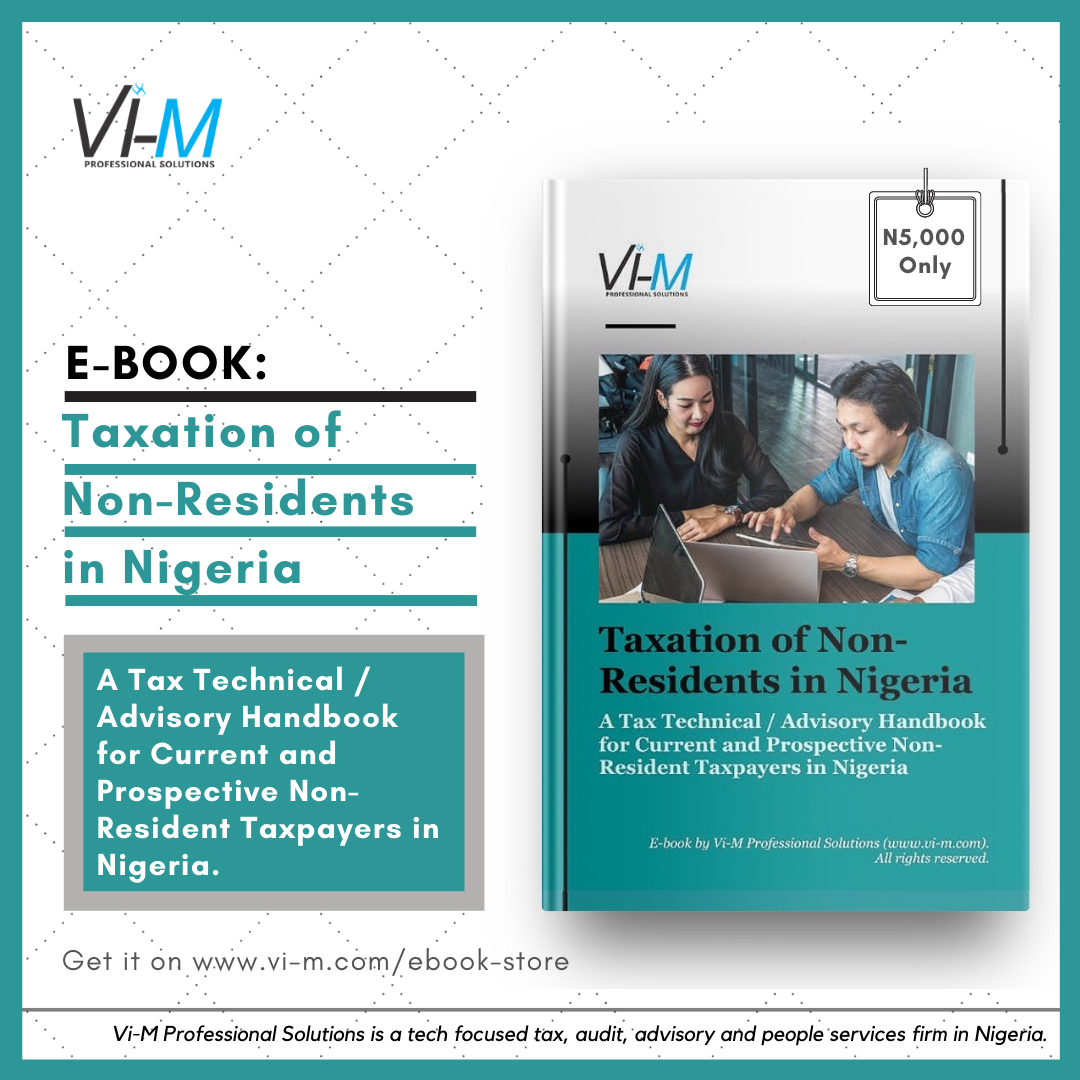
    1. Taxation of Non-Residents in Nigeria:

    An ebook for: 

    • Nigerians whose businesses entail dealing with non-Nigerians or Nigerians in diaspora. 
    • Non-Nigerians or Nigerians in diaspora with business interests or income yielding assets here in Nigeria. 
    • Expatriates in Nigeria

    This ebook saves non-resident taxpayers the usual huge cost of tax advisory in Nigeria. It also covers all the changes to the tax laws relating to non-resident taxation in Nigeria to date, including the meaning/ practical tax implication of ‘Significant Economic Presence’ for affected non-resident companies.

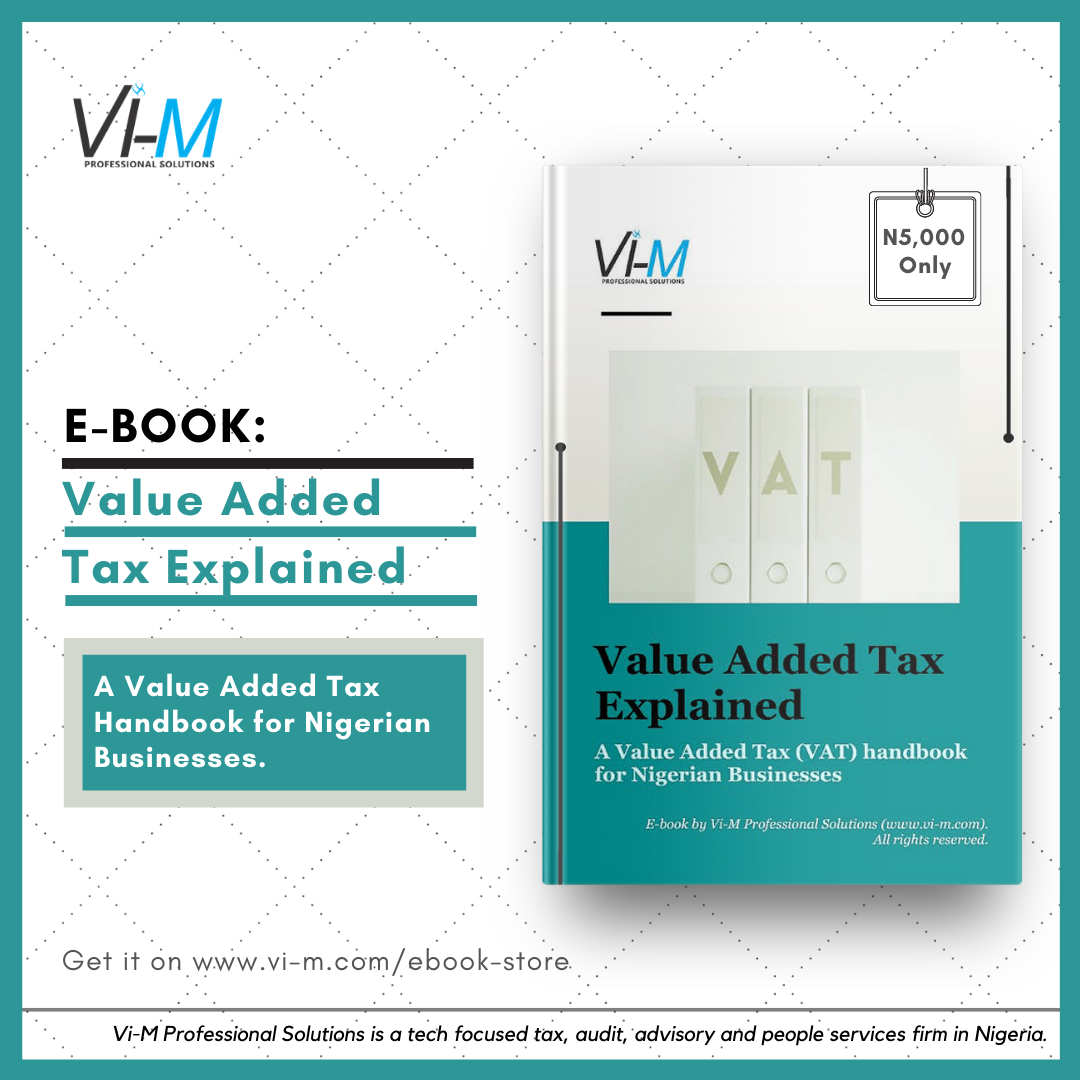
    2. Value Added Tax Explained:

    An ebook that offers:

    Comprehensive, practical information/ guide on Nigerian VAT- how it works, how to comply, how to compute, what is taxable, what is not taxable, practical controversies and how to navigate them, etc.

    3. How Companies’ Incomes are Taxed in Nigeria:

    An ebook for:

    Those who own / run companies (incorporated companies) of all sizes, to learn the step-by-step process of how companies’ incomes are assessed/ computed and filed – with other practical companies’ income tax issues clarified. 

    4. How to Get Tax Clearance Certificates (TCC) in Nigeria:

    An ebook:

    Which offers easy, step-by-step guide on how one can legitimately get Tax Clearance Certificate in Nigeria – both from the FIRS (for incorporated companies) and from any State Internal Revenue Service (for individuals, employees, self-employed persons and directors).

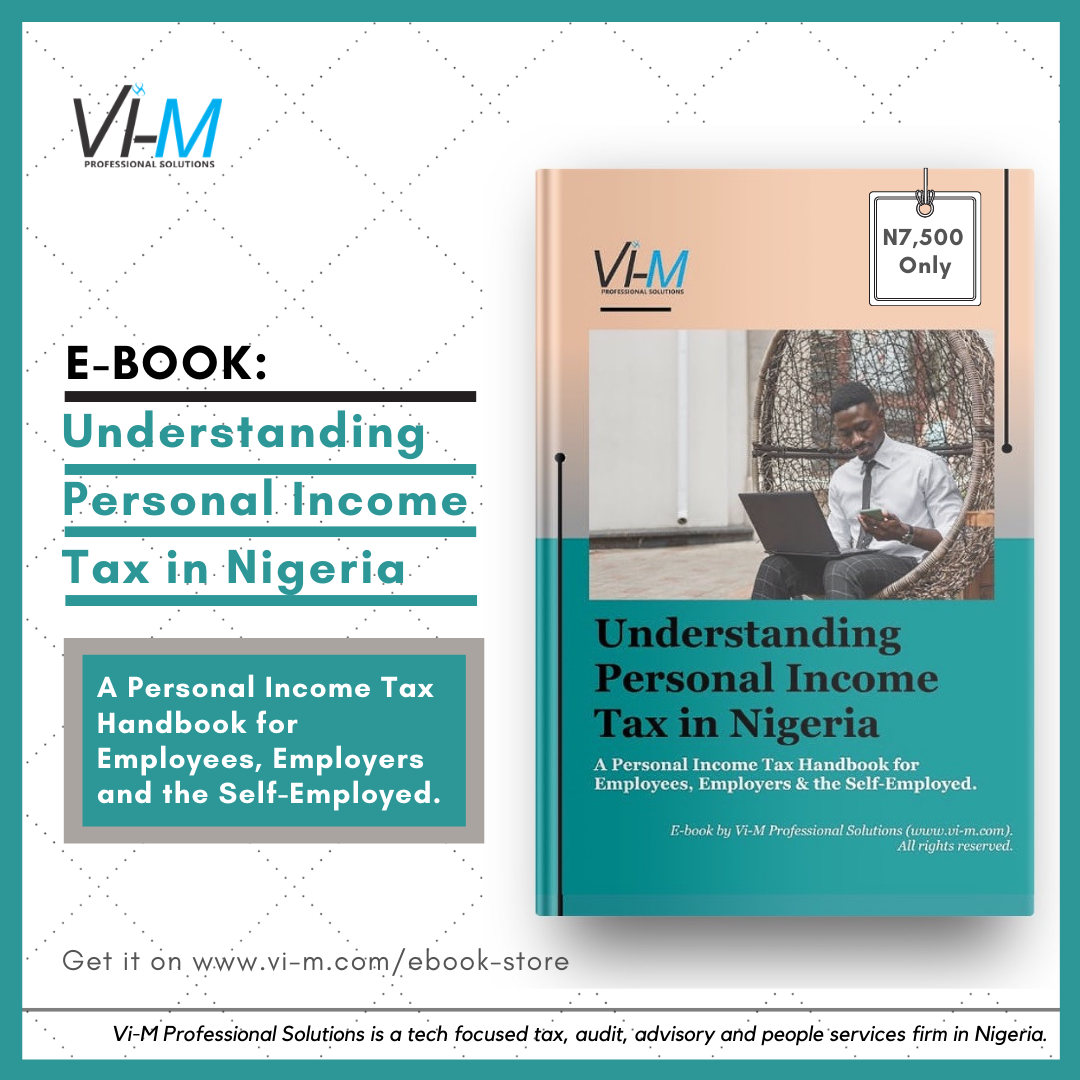
    5. Understanding Personal Income Tax in Nigeria:

    An ebook for:

    Employers, employees and the self-employed – easy, straight-to-the-point practical insights/ guide on how to compute, remit and generally comply to PAYE tax and PIT (Direct Assessment) tax for all individual taxpayers – covers all the provisions of the Finance Act 2019 and Finance Act 2020.

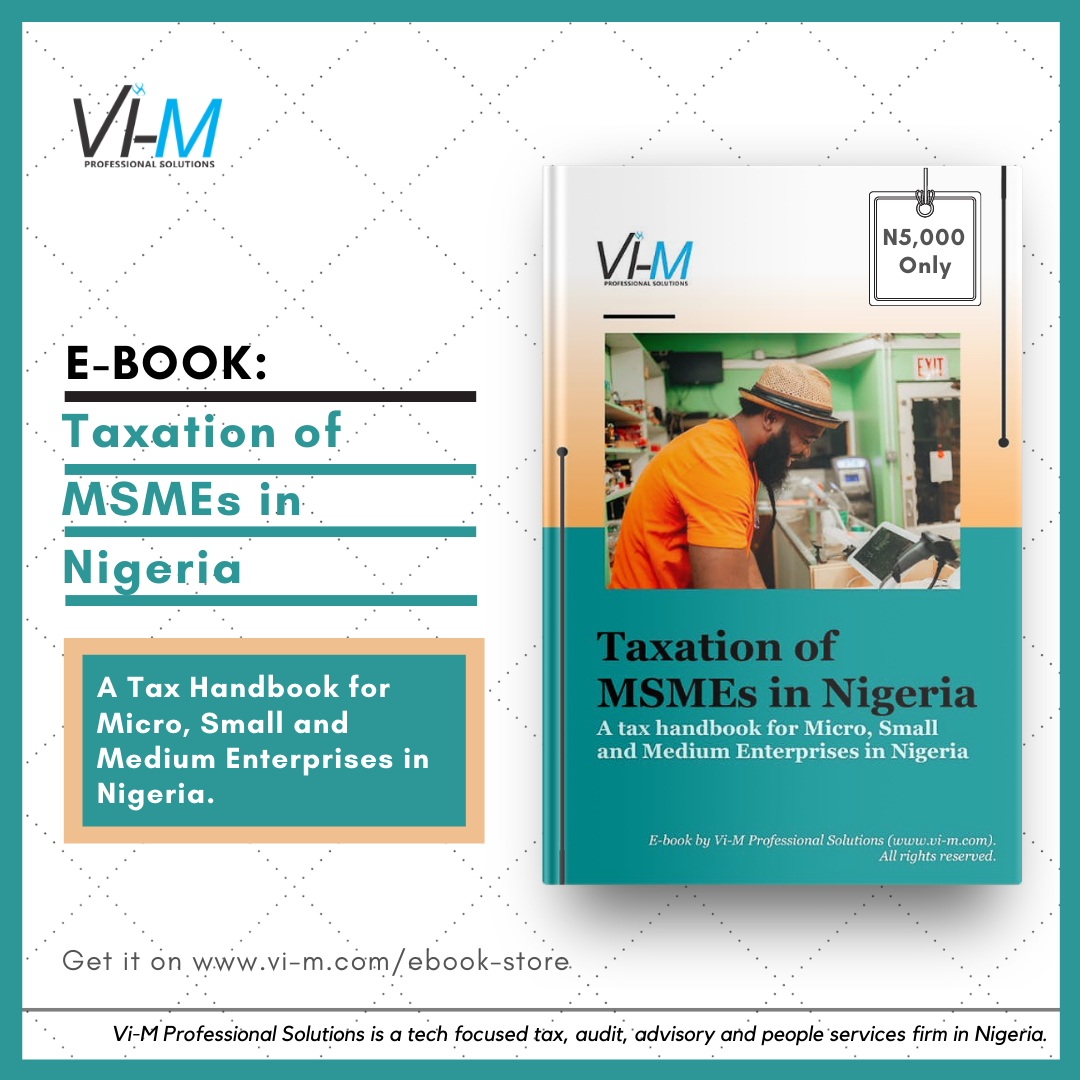
    6. Taxation of Micro, Small and Medium Enterprises (MSMEs) in Nigeria:

    An ebook for:

    Start-ups, micro, small and medium businesses in Nigeria –  a comprehensive, handy, easy-to-read and easy-to-understand tax guide to help Nigerian MSMEs understand how they are taxed, which taxes apply to them, which tax exemptions they should enjoy and scope of such exemptions, how and when taxes apply – captures all changes to the tax laws up to the Finance Act 2020.

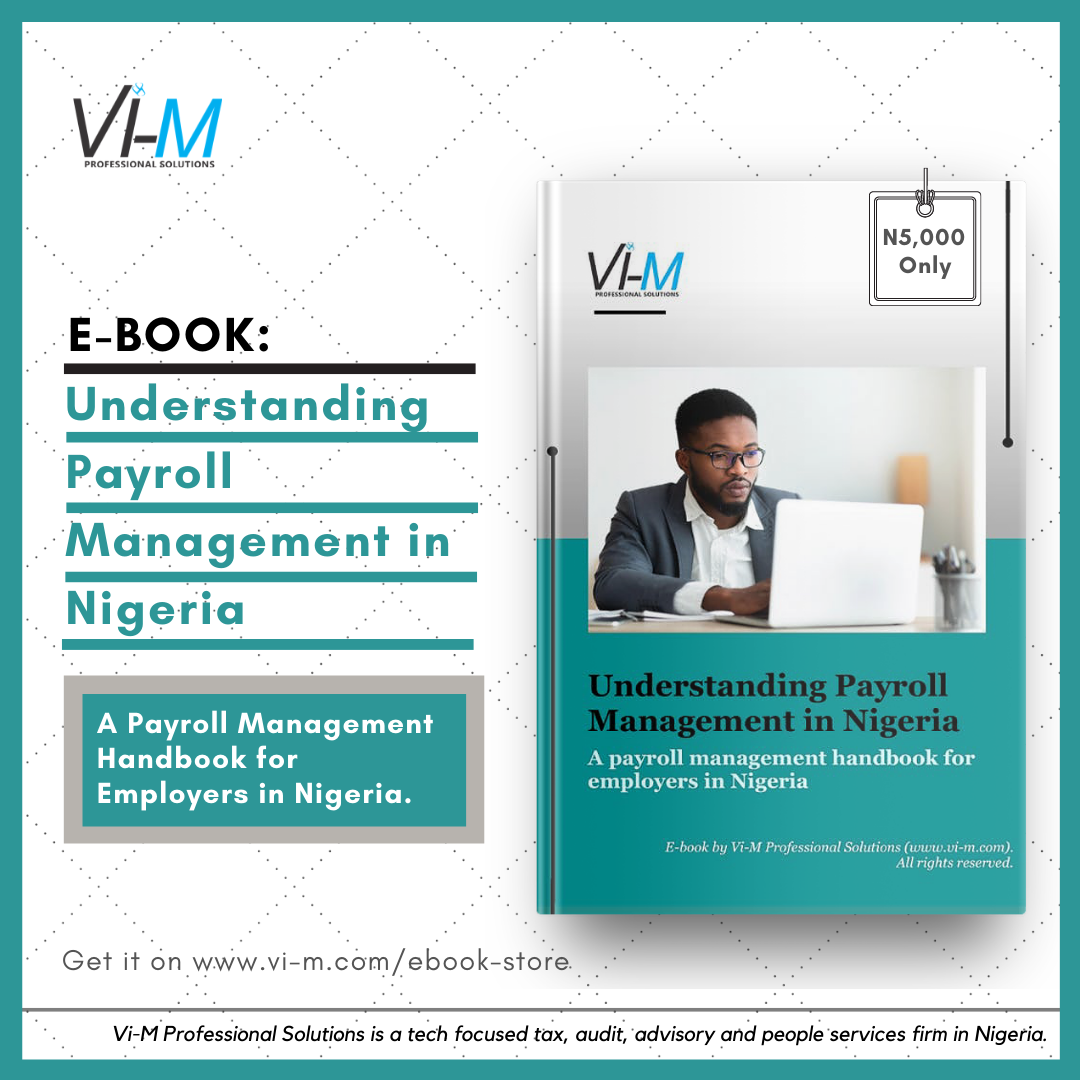
    7. Understanding Payroll Management in Nigeria:

    An ebook for:

    Employers in Nigeria – offers practical insights, methods, tips and recommendations for monthly payroll processes.

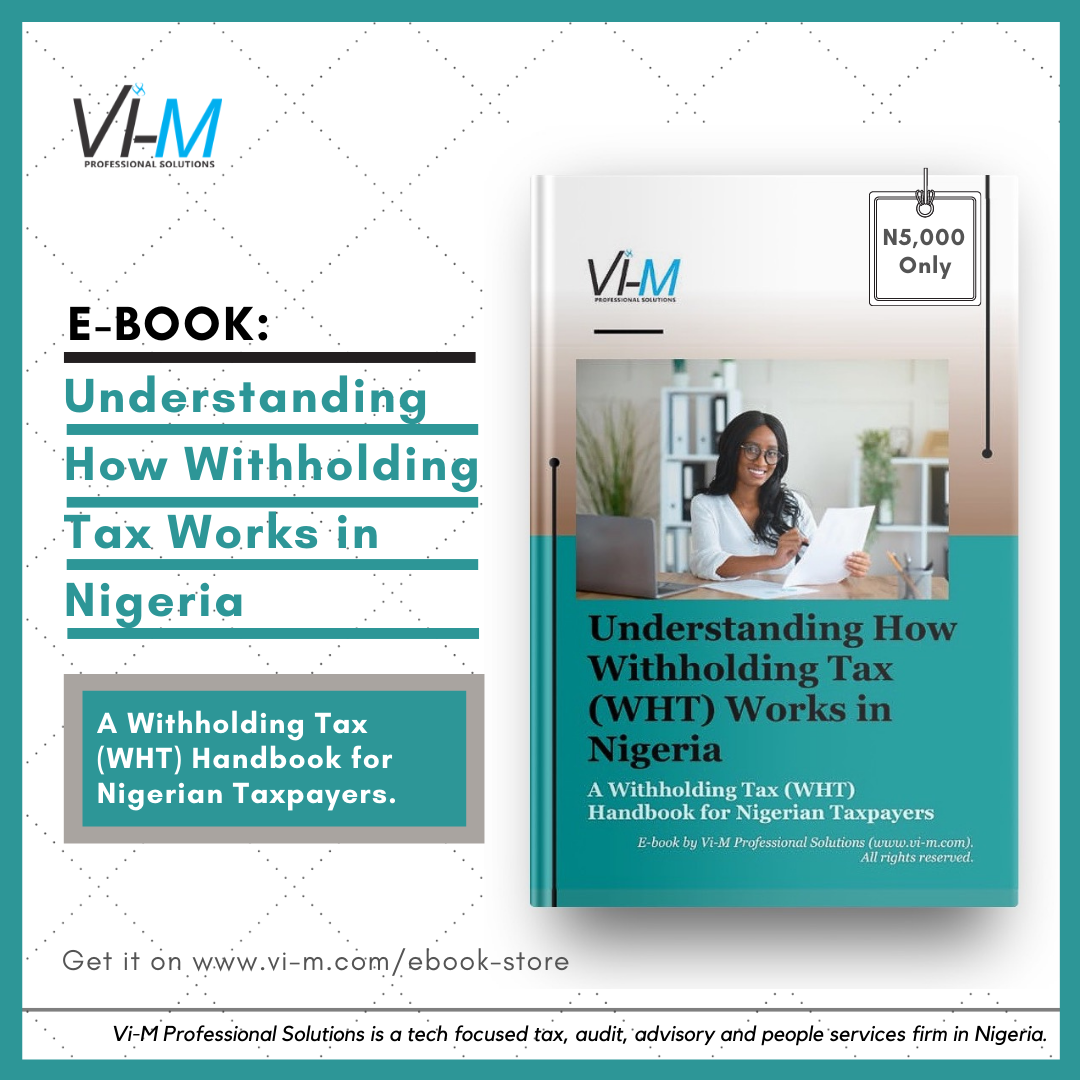
    8. Understanding How Withholding Tax (WHT) Works in Nigeria:

    An ebook for:

    Taxpayers who may want to understand fully what withholding means and how it works in Nigeria, particularly in practice, and with the changes in tax laws.

    Each of these ebooks costs NGN 5,000 only, with the exception of ‘Understanding Personal Income Tax in Nigeria’ which costs NGN7,500 only. 

    As earlier indicated, these ebooks can be purchased and downloaded from www.vi-m.com/ebook-store. The detailed tables of contents for all of the ebooks are also displayed on the respective product pages, for buyer review/ assessment before purchase.

    For any enquiries or assistance, please send an email to clients@vi-m.com or call +234 (810) 793 0666.

  • The Tax Law Book App is now updated with the provisions of the Finance Act, 2020.

    The Tax Law Book App is now updated with the provisions of the Finance Act, 2020.

    We are very excited to announce that our Tax Law Book App is now updated with the provisions of the Finance Act, 2020, on both the App Store and the Google Play Store.

    Several other tax resources such as the Federal Inland Revenue Service (FIRS)’ Information Circulars from 2020, Information Circular on Claim of Tax Treaties Benefits in Nigeria, Gazette Finance Act, 2020, Customs Tariff Schedule, Ministerial VAT Modification Order and Significant Economic Presence Order of 2020 are all also now included.

    Other useful tax and business insights, materials and tools have also now been added to the ‘Premium Insights’ section.

    The app is downloadable from the Stores for free. However, the tax laws can only be accessed after an in-app purchase (currently at N11,000). This purchase is once-off and provides lifetime access to the tax laws and their continuous updates, to the user.

    The Tax Law Book app is completely secure (verified by Google Play Protect and the App Store platforms). It also does NOT collect user data. Google Play or App Store, however, require users to sign into their accounts while making the in-app purchase. Like every other in-app purchase on the stores and on other apps, this is done to:

    • authenticate the purchaser, and ensure the purchase is authorised by the owner of the account.
    • enable attribution of purchase to the user, so that Google Play or Apple Store can grant the user access to the purchased contents (tax laws), whenever access is required.

    A demo video will be published soon, to enable users navigate the app effortlessly.

    Get Tax Law Book for IOS.

    Get Tax Law Book for Android.

  • FIRS ISSUES PUBLIC NOTICE ON THE CLARIFICATION ON PAYMENT IN INSTALMENTS BY SELF ASSESSMENT FILERS AS APPROVED BY THE FINANCE ACT, 2019

    FIRS ISSUES PUBLIC NOTICE ON THE CLARIFICATION ON PAYMENT IN INSTALMENTS BY SELF ASSESSMENT FILERS AS APPROVED BY THE FINANCE ACT, 2019

    On 29th March 2021, the FIRS issued a notice to the general public, taxpayers and tax practitioners to cater for the clarification on tax payment in instalments by self-assessment filers as approved by the Finance Act, 2019.

    Section 18 of the Finance Act, 2019 which amended Section 77 (5) of the Company Income Tax Act (CITA), cap C21 LFN 2004 states that:

    “(5) Every Company shall make payment of tax due on or before the due date of filing in one lump sum or in instalments, provided that: where the taxpayer pays in instalments –

    • The taxpayer shall first write, with evidence of payment of the first instalment, and obtain the approval of the service to pay in such number of instalments as may be approved by the service; and
    • The final instalment must be paid on or before the due date of filing.”

    (5b) Any balance of taxes unpaid as at the due date shall attract interest and penalties as provided in the Act or any other relevant law for failure to pay on the due date in accordance.”

    The notice according to the FIRS, elucidates on the section above stating that “Any Company that wishes to pay by instalments must have applied in writing, before the due date of filing, attaching evidence of full payment of Tertiary Education Tax (TEDT) and first instalment of the Companies Income Tax (CIT) due. It is important to note that the last instalment must be paid on or before the due date for filing tax returns, otherwise penalty and interest will be charged after the due date.”

    All taxpayers have been charged to ensure compliance with the aforementioned provisions of the Act as failure to comply attracts the measures for the recovery of tax as enshrined in Section 85 (1) of CITA cap C21 LFN 2004 as amended and Section 32 of FIRS Establishment Act (2007), which authorize addition for non-payment and enforcement of payment.

    FIRS reaffirms that tax offices will provide adequate assistance to tax payers to satisfy the requirements of the Finance Act, 2019 as regards payments by instalment.

    Click here to view the FIRS Publication.

    For further clarifications or professional assistance in connection to this subject or any other matter, please contact Vi-M Professional Solutions on clients@vi-m.com or www.vi-m.com.

  • FIRS ISSUES PUBLIC NOTICE ON THE DEPLOYMENT OF AUTOMATED TAX ADMINISTRATION SOLUTION

    FIRS ISSUES PUBLIC NOTICE ON THE DEPLOYMENT OF AUTOMATED TAX ADMINISTRATION SOLUTION

    The Federal Inland Revenue Service (FIRS) on 30th March 2021, gave a notice which is in harmony with the provisions of Section 25(4) of the Federal Inland Revenue Service Establishment Act 2007 as amended by section 51 of Finance Act 2019.

    This notice was addressed to the general public, tax practitioners and, particularly, all taxable persons (including individuals, trustees, partnerships, companies, corporations, etc.) as follows:

    • The Federal Inland Revenue Service (the FIRS) shall, not earlier than 30 days from the date of publication of this notice, begin to connect its Automated Tax Administration System to access, for tax purposes, relevant records, data or information stored or otherwise residing in computers or other electronic devices (including cloud computing facilities) maintained, operated, controlled or owned by relevant persons or their agents.
    • The connection shall include relevant point of sales or invoicing platforms of all taxable persons (individuals, enterprises, companies and entities).
    • Relevant persons are required to grant FIRS access to all computers, electronic devices or cloud computing facilities wherein records, data or information are stored or otherwise residing (Section 26, FIRS Act).

    The attention of the tax paying public is drawn to the penalties prescribed in Section 26(3) of the FIRS Establishment Act for Failure to grant the necessary access.

    Click here to view the FIRS Publication.

    To find out about the relevant taxes in Nigeria, which FIRS can specifically track with automated solutions, please visit our ebook store. To find out all about VAT and how it works in Nigeria, please refer to our ebook on ‘Value Added Tax Explained‘.

    For further clarifications or professional assistance in connection to this subject, please contact Vi-M Professional Solutions on clients@vi-m.com or www.vi-m.com.

  • FIRS ISSUES PUBLIC NOTICE TO ANY PERSON WHO DISPOSED CHARGEABLE ASSETS TO FILE CAPITAL GAINS TAX (CGT) RETURNS

    FIRS ISSUES PUBLIC NOTICE TO ANY PERSON WHO DISPOSED CHARGEABLE ASSETS TO FILE CAPITAL GAINS TAX (CGT) RETURNS

    The amendment to the Capital Gains Tax Act, by the Finance Act 2020 mandates every person who disposed a chargeable asset to compute the Capital Gains Tax, file self-assessment returns and pay the tax computed thereon.  This amendment came into effect from 1st January 2021.

    Hence, the FIRS has issued a notice on 31st March 2021 to all taxpayers (companies, partnership, executors, trustees, community, families or individuals), tax practitioners and the general public as follows:

    • The Capital Gains Tax Act (CGTA) (as amended) mandates every person who disposes a chargeable asset to bi-annually compute the Capital Gains Tax, file self-assessment returns and pay the tax computed, in respect of the chargeable assets disposed, to the relevant tax authority.
    • The due date of filling for Capital Gains Tax returns and payment of Capital Gains Tax is the earlier of 30th June and 31st December immediately following the disposal.
    • As such, any taxpayers having disposed a chargeable asset is required to compute the Capital Gains Tax, file self-assessment return and pay the tax in respect of the following chargeable assets:

    a. Chargeable assets disposed from 1st January in a year to 30th June of that year, not later than 30th June

    b. Chargeable assets disposed from 1st July to 31st December each year, not later than 31st December

    c. Chargeable assets disposed prior to the coming into effect of Finance Act 2020, not later than 30th June 2021

    FIRS cautions that any tax due and unpaid by the due date shall attract interest and penalties as provided in the enabling legislation.

    Click here to view the FIRS Publication.

    For further clarifications or professional assistance in connection to this subject, please contact Vi-M Professional Solutions on clients@vi-m.com or www.vi-m.com.

  • FIRS ISSUES PUBLIC NOTICE TO ALL APPROVED ENTERPRISES OPERATING IN THE FREE TRADE ZONES, EXPORT PROCESSING ZONES AND OIL AND GAS FREE ZONES TO FILE INCOME TAX RETURNS

    FIRS ISSUES PUBLIC NOTICE TO ALL APPROVED ENTERPRISES OPERATING IN THE FREE TRADE ZONES, EXPORT PROCESSING ZONES AND OIL AND GAS FREE ZONES TO FILE INCOME TAX RETURNS

    The Federal Inland Revenue service (FIRS) on the 30th of March 2021, issued a public notice in accordance with Section 18 (1) of the Nigeria Export Processing Zones Authority (NEPZA), and the Oil and Gas Free Zone Authority (OGFZA) Acts as amended by section 58 and 59 of the Finance Act 2020, which came into effect 1st January 2021.

    The notice has been given by the FIRS to all enterprises registered and operating in the Nigeria Export Processing and Oil & Gas Free Zones (the zones), tax practitioners and the general public asserting that:

    The NEPZA Act and OGFZA Act (as amended) mandates all enterprises registered and operating in the zones to file income tax returns in accordance with the provisions of the Companies Income Tax Act (CITA).

    Hence, all enterprises registered and operating in the zones are required to:

    1. to file income tax returns for 2021 and subsequent years of assessment; and
    2. to compute income tax and pay the tax due (if any)

    The returns should be in the manner and time as specified by CITA.

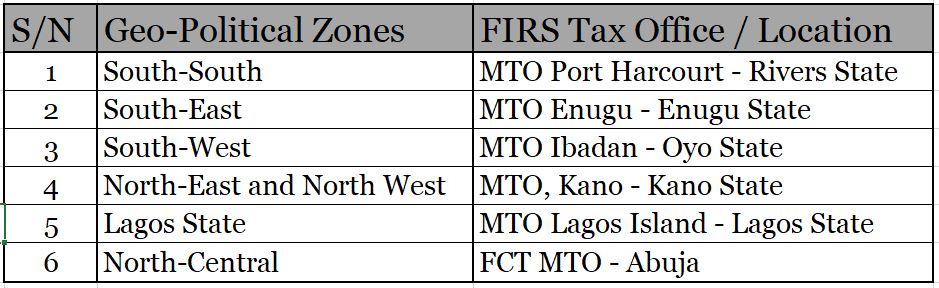
    To allow for ease of compliance, FIRS has further highlighted / directed that enterprises operating in the relevant “Geo-Political Zones” are required to file their income tax returns in the respective FIRS offices as indicated below:

    The publication also reiterates that relevant penalties prescribed by CITA or Federal Inland Revenue Service (Establishment) Act of 2007 shall apply to any company that fails to comply with the filing requirements as regards due dates.

    Click here to view the FIRS Publication.

    For further clarifications or professional assistance in connection with your filing requirements, please contact Vi-M Professional Solutions on clients@vi-m.com or www.vi-m.com.

  • Wishing all Women, a Happy International Women’s Day!

    Wishing all Women, a Happy International Women’s Day!

    On this day, we celebrate all women for what they do in our families, society, business and everywhere.  We recognize, appreciate and celebrate women owned businesses and all those playing an active role in their families and businesses.

    Thus, at Vi-M Professional Solutions (a female owned business), we are offering free advisory, support or guidance on any personal or business tax related issues in Nigeria – please see attached flyer above for more details.

    Dates: – Monday 8th and Tuesday 9th March, 2021
    Time: – 9am to 4pm (WAT)
    Location – Click here www.vi-m.com/tax-discourse/, to learn more OR send your questions via WhatsApp +234 817 320 3657
    Rate: – free

    Tax Discourse’, with Vi-M Professional Solutions is an avenue through which we at Vi-M, make personalized and professional tax advisory accessible and very affordable to every Nigerian taxpayer; an initiative, which will enable us support the everyday Nigerian taxpayer (Women) with strategic insights and knowledge (on a one-going basis) on how to better navigate any tax challenge.

    For any enquiries or assistance, please send an email to clients@vi-m.com OR visit our website www.vi-m.com.

    Congratulations to all women and do have a great celebration!

    #ChooseToChallenge