Deprecated: Optional parameter $is declared before required parameter $frame_val is implicitly treated as a required parameter in /home/vgi72asz3yge/public_html/Vi-M/wp-content/plugins/revslider/includes/operations.class.php on line 656

Warning: "continue" targeting switch is equivalent to "break". Did you mean to use "continue 2"? in /home/vgi72asz3yge/public_html/Vi-M/wp-content/plugins/revslider/includes/operations.class.php on line 2858

Warning: "continue" targeting switch is equivalent to "break". Did you mean to use "continue 2"? in /home/vgi72asz3yge/public_html/Vi-M/wp-content/plugins/revslider/includes/operations.class.php on line 2862

Deprecated: Optional parameter $publishedOnly declared before required parameter $slide is implicitly treated as a required parameter in /home/vgi72asz3yge/public_html/Vi-M/wp-content/plugins/revslider/includes/slider.class.php on line 2284

Warning: "continue" targeting switch is equivalent to "break". Did you mean to use "continue 2"? in /home/vgi72asz3yge/public_html/Vi-M/wp-content/plugins/revslider/includes/output.class.php on line 3708

Deprecated: Optional parameter $item_count declared before required parameter $app_secret is implicitly treated as a required parameter in /home/vgi72asz3yge/public_html/Vi-M/wp-content/plugins/revslider/includes/external-sources.class.php on line 67

Deprecated: Optional parameter $item_count declared before required parameter $app_secret is implicitly treated as a required parameter in /home/vgi72asz3yge/public_html/Vi-M/wp-content/plugins/revslider/includes/external-sources.class.php on line 89

Deprecated: Optional parameter $item_count declared before required parameter $current_photoset is implicitly treated as a required parameter in /home/vgi72asz3yge/public_html/Vi-M/wp-content/plugins/revslider/includes/external-sources.class.php on line 1119
Finance Act 2019 – Vi-M Professional Solutions

Category: Finance Act 2019

  • Finance Minister Issues Executive Order on ‘Significant Economic Presence’ for Taxation of Non-Nigerian Companies

    The Federal Minister of Finance, Budget and National planning has recently issued “Companies Income Tax (Significant Economic Presence) Order, 2020′.

    The Order specifies what “Significant Economic Presence” means for the purpose of taxation of Non-Nigerian companies operating in the digital space in Nigeria in line with section 13(2)(c) of the Companies Income Tax Act (CITA) as amended by the Finance Act, 2019.

    It also specifies what “Significant Economic Presence” means for non-Nigerian companies carrying on trade or business comprising in provision of consultancy, management, professional and technical services in Nigeria in line with section 13(2)(e) of the Companies Income Tax Act (CITA) as amended by the Finance Act, 2019. 

    The Order is effective from 3rd February, 2020 and can be downloaded here.

    Highlights:

    1. Foreign owned/ controlled digital technology platforms/ tools that will qualify their non-Nigerian owners as having “Significant Economic Presence” (interpreted from the descriptions made by the Executive Order) for Companies Income Tax purposes in Nigeria would include: 

    a) Platforms selling digital products/ downloads, ecommerce platforms, social media platforms, mobile apps, web applications, app stores, accounting, payroll or ERP software providers, cloud platforms, data/ internet providers, freelance or job websites connecting suppliers with customers in Nigeria, eg. Fiverr.com, solutions such as Google solutions, video and music streaming platforms such as Netflix, YouTube, vimeo etc. as long as the aggregate earnings of those companies in Nigeria from one or combination of their digital solutions/ activities become more than N25 million in any accounting year.

    b) Non- Nigerian companies using ‘.ng’ domains or those that register their website addresses in Nigeria. There is no minimum turnover threshold attached to this condition but the provisions of CITA on ‘Small Companies’ would most reasonably apply.

    c) Digital platforms targeted to or has a purposeful or sustained interaction with Nigerian buyers, including presenting prices of their products and services in Naira or giving the option to buy in Naira. There is no minimum turnover threshold attached to this condition but the provisions of CITA on ‘Small Companies’ would also most reasonably apply.

    2. Non-Nigerian companies falling into the above 3 criteria will create a ‘Significant Economic Presence’ in Nigeria that would make them taxable under the provisions of the Companies Income Tax Act (CITA), just like other ‘Fixed bases’ and ‘Permanent Establishments’ of non-Nigerian companies. Rate of tax according to the provisions of CITA is either nil (for companies making N25million or less in annual gross turnover) or 20% or 30% based on turnover threshold in line with the Finance Act, 2019.

    3. Nigerian businesses using these digital solutions for their businesses would need to withhold tax from payments made to these foreign companies. Rate of withholding tax is not specified. However, it should be 5% when the transaction is treated like a general contract of supply, but given that digital technology is specialised, a more appropriate rate may be 10%.

    4. Some practical tax implications for Nigerian businesses using these digital platforms include:

    a) Most of these foreign companies are yet unaware of the changes in the Nigerian tax laws as it applies to them (even if they do, they may care less until strict measures are applied to them) and this means that they will not allow any withholding tax deductions from their payments. This will imply that Nigerian businesses may be mandated to bear the withholding tax burden on these transactions. 

    b).  Where withholding tax is borne by a Nigerian company on behalf of another person, this amount will also be taxable (for the Nigerian company) under CITA as it will NOT be allowed as a deductible business expense for tax purposes.

    c). App developers (businesses hosting apps on app stores) and partners (such as accounting software partners) may, by virtue of their agreements with the platform owners, be required to bear the tax applicable on the portion of the shared revenues attributable to the foreign platform owners. In this case, nos. (a) and (b) above would also apply to them.

    d). The practicable alternative for Nigerian businesses would be to ONLY use digital solutions offered by these non-resident companies for free.

    e). The second practicable alternative for Nigerian businesses is to buy off-the-shelf,  one-time-payment digital solutions.  

    f). Digital technology and platforms are being embraced by Nigerian businesses to make business easier and more effective. These new provisions and the practical tax implications places additional burdens which negates the purpose of embracing digital technology. 

    g). The ramifications of digital technology are so broad that neither the tax authorities nor the Nigerian businesses using these digital solutions can fully articulate them in order to determine the appropriate taxes that may apply. 

    h). Technology is a specialised field and lack of proper understanding of what it all entails may lead both taxpayers and tax authorities to making incorrect tax assessments and engaging in long drawn tax disputes eventually. 

    5. The second part of the Executive Order describes what “Significant Economic Presence” means for non-resident companies carrying on trade or business comprising in  provision of technical services (which includes training, advertising services or provision of personnel), consultancy, management and professional services in Nigeria.

    These non-Nigerian companies will be taxable at the rate of 10% (withholding tax), which will become the final Nigerian tax in the case of payments received for the aforementioned services: 

    i. From a Nigerian resident, or

    ii. From a fixed base of a non-Nigerian company 

    Payments relating to the following are excluded from creating “Significant Economic Presence”:
    a). Payments made to employees in an employment contract.
    b). Payments for these services made for teaching in or by educational institutions.
    c). Payments for such services made by the foreign fixed bases of Nigerian companies.

    6. In this regard,  Nigerian businesses (and fixed bases or agents of non-Nigerian companies) paying for these services would be required to withhold tax at 10% from the payments made to these foreign companies on these services. Such withholding tax would be the final Nigerian tax.

  • Webinar Series to Review and Discuss FIRS’ 7 Information Circulars on the Finance Act, 2019

    The Federal Inland Revenue Service (FIRS) has recently issued Information Circulars clarifying many provisions of the Finance Act, 2019. There are Seven different Information Circulars dealing with different topics under the Finance Act, 2019.

    We are organising a 3-part (1.5 hr each) webinar series to discuss the contents of the Information Circulars vis a vis the provisions of the Finance Act, 2019 and we will be highlighting what it all implies for taxpayers in simple practical terms.

    The webinars will hold everyday from Tuesday, 19 May 2020 to Thursday, 21 May 2020, from 12.00pm to 1.30 pm on each of the days.

    On day 1, 19 May 2020, we will focus on detailed discussions on the implications of the contents of FIRS’ Information Circular on Companies Income Tax.

    On day 2, 20 May 2020, we will discuss FIRS’ Information Circular on Value Added Tax and its practical implications.

    On day 3, 21 May 2020, we will discuss FIRS’ Information Circular on Stamp Duties, commencement of business, cessation of business and business re-organisation.

    This three-part webinar series is offered at a one-time registration fee of N30,000per attendee.

    Please visit this link to register for the webinar: https://us02web.zoom.us/webinar/register/WN_UQ6o6FabQraXY7aSJSWKXQ

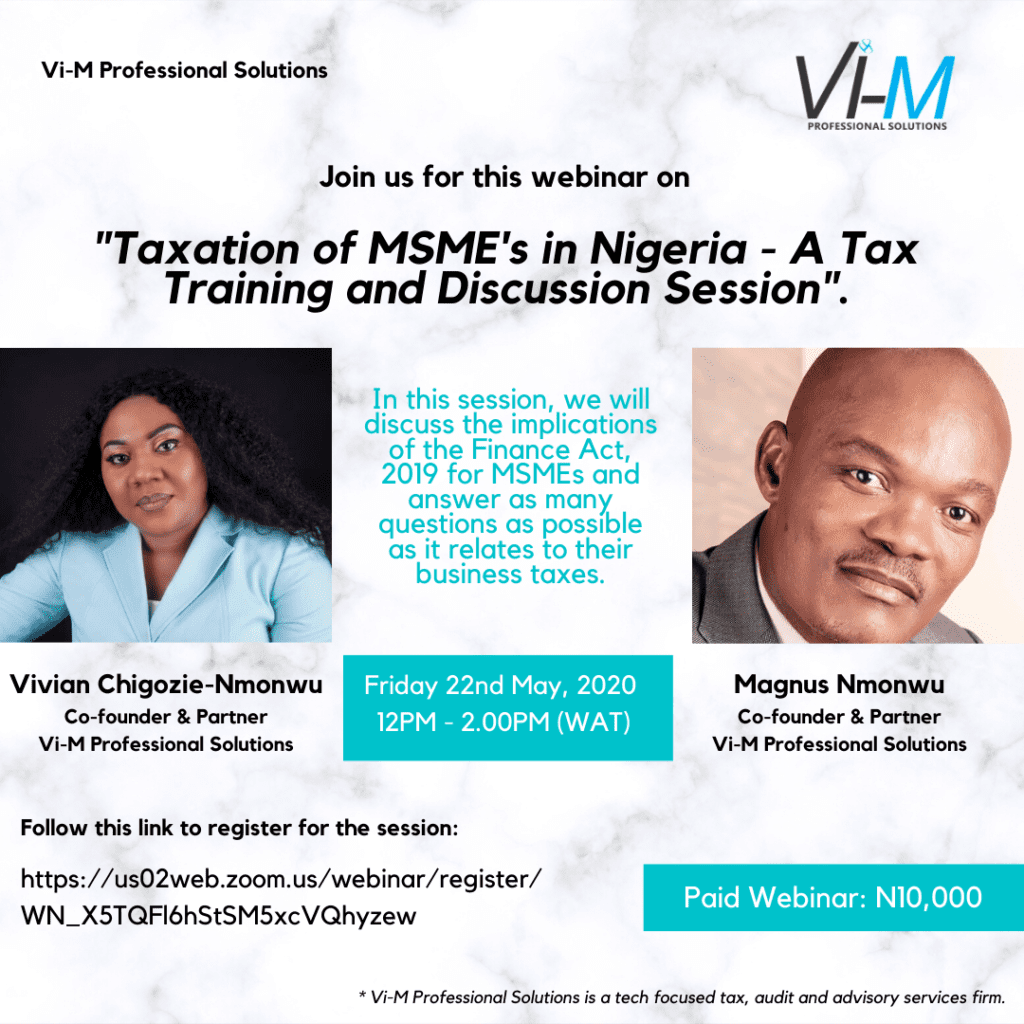
    On day 4, 22 May 2020, from 12.00pm to 2.00pm, we will have a special wrap-up session titled: “Taxation of MSMEs in Nigeria: A Tax Training and Discussion Session”.

     This is driven by the fact that many small and medium sized business owners still find it difficult to comprehend tax and how it applies to their businesses.

    The periodic changes in tax laws do not also help matters. The Finance Act, 2019 presents a major change in Nigeria’s tax regime that is partly but not totally beneficial to MSMEs. 

    The clarifications made by the FIRS in its recently released Information Circulars on the Finance Act, 2019 even places more tax burden on MSMEs than earlier presented by the provisions of the Finance Act, 2019.  

    Through this 4th day wrap up webinar, Vi-M will:

    1. Discuss the implications of the Finance Act, 2019 for MSMEs, particularly as presented by the Federal Inland Revenue Service in its recently released Information Circulars; and
    2. Answer as many questions as possible as it relates to taxes for MSMEs.

    This webinar is offered at a registration fee of N10,000 per attendee.

    Please visit this link to register for the MSME webinar: https://us02web.zoom.us/webinar/register/WN_X5TQFl6hStSM5xcVQhyzew

    Find below the event flyers for both webinars. To learn more about the webinars, please send an email to clients@vi-m.com

  • FIRS Issues Information Circulars to Clarify the Provisions of the Finance Act, 2019

    The Federal Inland Revenue Service (FIRS) has recently issued Information Circulars clarifying many provisions of the Finance Act, 2019.
     
    There are Seven different Information Circulars dealing with different topics under the Finance Act, 2019 as follows:
     

    1. Information Circular on Companies Income Tax related provisions of the Finance Act, 2019. Download here.
    2. Information Circular on Value Added Tax related provisions of the Finance Act, 2019. Download here.
    3. Information Circular on Stamp Duties related provisions of the Finance Act. Download here.
    4. Information Circular on provisions pertaining to Real Estate Investment Companies. Download here.
    5. Information Circular on provisions pertaining to Insurance Companies. Download here.
    6. Information Circular on provisions relating to commencement of business, cessation of business and re-organisation of business. Download here.
    7. Information Circular on provisions of the Finance Act as it relates to Securities Lending Transactions. Download here.
       

    We will be organising a 3-part (1.5 hr each) webinar series to discuss the contents of the Information Circulars vis a vis the provisions of the Finance Act, 2019 and we will be highlighting what it all implies for taxpayers in simple practical terms.

    The webinars will hold everyday from Tuesday, 19 May 2020 to Thursday, 21 May 2020, from 12.00pm to 1.30 pm on each of the days.

    On day 1, 19 May 2020, we will focus on detailed discussions on the implications of the contents of FIRS’ Information Circular on Companies Income Tax.

    On day 2, 20 May 2020, we will discuss FIRS’ Information Circular on Value Added Tax and its practical implications.

    On day 3, 21 May 2020, we will discuss FIRS’ Information Circular on Stamp Duties, commencement of business, cessation of business and business re-organisation.

    This three-part webinar series is offered at a one-time registration fee of N30,000 per attendee.

    Please visit this link to register for the webinar: https://us02web.zoom.us/webinar/register/WN_UQ6o6FabQraXY7aSJSWKXQ

    On day 4, 22 May 2020, from 12.00pm to 2.00pm, we will have a special wrap-up session titled: “Taxation of MSMEs in Nigeria: A Tax Training and Discussion Session”.

     This is driven by the fact that many small and medium sized business owners still find it difficult to comprehend tax and how it applies to their businesses.

    The periodic changes in tax laws do not also help matters. The Finance Act, 2019 presents a major change in Nigeria’s tax regime that is partly but not totally beneficial to MSMEs. 

    The clarifications made by the FIRS in its recently released Information Circulars on the Finance Act, 2019 even places more tax burden on MSMEs than earlier presented by the provisions of the Finance Act, 2019.  

    Through this 4th day wrap up webinar, Vi-M will:

    1. Discuss the implications of the Finance Act, 2019 for MSMEs, particularly as presented by the Federal Inland Revenue Service in its recently released Information Circulars; and
    2. Answer as many questions as possible as it relates to taxes for MSMEs.

    This webinar is offered at a registration fee of N10,000 per attendee.

    Please visit this link to register for the MSME webinar: https://us02web.zoom.us/webinar/register/WN_X5TQFl6hStSM5xcVQhyzew

    Find below the event flyers for both webinars. To learn more about the webinars, please send an email to clients@vi-m.com. 

  • More Thoughts About the Tax Law Book App

    1. So much talk about the Finance Act, 2019.

    Have you seen what is inside of it? Someone once said it has over 100 provisions, while it has only 57! 

    Inside the Tax Law Book App, you will not only find that all the 7 affected tax laws have been updated with its new provisions, you will also see the original PDF version to read through!

    2. Yes, they say so many things about taxes.

    They said it the other day in that conference. It’s on those social media pages and educational publications.

    Yes, the tax man said it too.

    Remember that opinions are subject to individual differences!

    Why not check ‘what it says’ yourself?

    Get the mobile tax laws, get Tax Law Book and check for yourself.

    3. You need loads of data to attend ALL of the several webinars. 

    You do not need one tenth of all that data to READ.

    Best of all, what you are reading is right there on your mobile phone when you get the Tax Law Book App.

    Start now to read & learn its contents.

    4. Do you know what tax exemptions you qualify for? Or the conditions attached to your tax exemptions? 

    Find out directly from the laws. Check for yourself what taxes apply to you and how. 

    Do not understand something? Send us a message from the app and we will clarify for free!

    Get your mobile tax companion.

    Get the Tax Law Book App.

    5. Stop wishing away TAX from your business and finances.

    You are only wishing yourself lack of money.

     How? Taxes follow money! They are but a percentage of the money you make.

    MAKE NO MONEY, PAY NO TAXES.

    You want to be a billionaire right?

    Then stop wishing away taxes. Plan for them alongside your billions (Say Amen?)

    Empower yourself with the Tax Law Book App.

  • Introducing Premium Tax Law Book App (by Vi-M): Finance Act, 2019 in a Mobile App

    Introducing Premium Tax Law Book App (by Vi-M): Finance Act, 2019 in a Mobile App

    We at Vi-M Professional Solutions, a tech focused Tax, Audit, Advisory and People Services Firm, are using this opportunity to announce the release / launch of our rebranded Tax Law Book (“TLB” “The App).  

    This rebranded version of the TLB contains all legislated TAX RESOURCES and much more for our intended subscribers on any handheld device.  The laws in TLB have been updated with the provisions of the gazetted version of the Finance Act 2019, making it easier to read, interpret and apply, in conjunction with the existing provisions of the laws. The Deep Offshore and Inland Basin Production Sharing Contracts Act has also been updated with the amendments made in 2019.

    The App is available on both the IOS and Android stores with effect from 8th April 2020.  We therefore call on all business owners, individuals and the general public to download and make use of the application.  

    TLB is useful to all business owners, investors, employees, finance and tax practitioners, taxpayers and students in related fields.

    Other Features:

    In-app Purchase

    Installing the application on any device is free.  However, in view of the amount of work that has gone into updating the relevant legislations and making it adaptable to users / subscribers, accessing the Laws and Regulations section attracts a one time in-app purchase of N7,200, on both the IOS and Android versions.

    Resources Included

    This onetime payment gives every subscriber unlimited access to the various legislations in the country that is available in the App on the go.  This is also inclusive of the various public notices, treaties, information circulates and treaties (frequently updated) as released by the relevant government agencies from time to time.

    Search and zoom functionalities

    Subscribers of the App are able to carry out a search function on the various legislations using certain unique words, which gives them the freedom NOT to memorize each and every section, sub-section, content or paragraphs of the numerous legislations in the country.  The App also comes with a zoom functionality for enhanced user interaction.

    Continuous Insights

    Our subscribers are able to get insights from our blog post for free and it comes with a notification feature for new post if and when published.

    Book Service with Ease and on Your Terms

    All users are able to book for services directly from the App, indicating their respective budget, timeline and other specifications, all from within the App.  One can also send messages or enquiries with ease from ‘Send a Message’ menu tab of the App.

    Premium Insights

    Coming soon – a unique and formidable companion for all users of the app. 

    Social Media and Contact Links

    There are several other useful links on the app, which every subscriber can use to interact with Vi-M Professional Solutions.


    Please click on link to watch a YouTube video demo of the TLB – https://youtu.be/siNm99s_ftA.

    We call on you to visit the app stores below to download the TLB and connect to the world of mobile tax laws:

    IOS or Apple store – https://apps.apple.com/app/id1451834267

    Android or Google – https://play.google.com/store/apps/details?id=com.vi_m.tax1

    For more enquiries on TLB, please send an email to clients@vi-m.com.

  • Your 2019 Year-end Audit

    Your 2019 Year-end Audit

    Is your business’ financial year-end 31 December?
     
    While you get your team up to speed with the new Finance Act and how certain processes would change as a result, do not forget to finalise your 2019 year-end processes and get your financial statements, audited.
     
    Here are some of the benefits of auditing your financial statements promptly:
     
    1. If you have in-house finance function, you get to find out its areas of weaknesses so you can address it.
     
    2. You would need audited accounts to file your  Company’s Income Tax (CIT) or Personal Income Tax (PIT) returns.

    • Filing your Company’s Income Tax (CIT) returns by the end of this month will fetch you tax bonus/ credit.
    • Personal Income Tax (PIT) direct assessment filing (for business names and enterprises) is also due for filing by this month end.

     
    3. You would be complying with the requirements of the Companies and Allied Matters Act and other Regulators in your industry. 
     
    4. Lenders and investors require your audited accounts for appraisals and due diligence, therefore, if you are planning to raise additional funds externally, you would need up-to-date audited financial statements. 
     
    5. Proper books of accounts/ financial statements help you make better business decisions and run the business better. 
     
    6. You satisfy the business stakeholders with complete and credible financials.
     
    7. When your audited accounts are complete and accurate, you feel good about your work and business.
     
    Share your external audit needs or requests with us by sending an email to clients@vi-m.com.

  • Finance Act, 2019: the Benefits to Nigerian Taxpayers (Vi-M Finance Act Series | Issue 1)

    Finance Act, 2019: the Benefits to Nigerian Taxpayers (Vi-M Finance Act Series | Issue 1)

    The gazette copy (download here) of Nigeria’s Finance Act, 2019 (“the Act”) contains 57 provisions that amend 7 existing tax laws. It became effective from 13 January 2020 as specified in the Act.

    Complementing Nigeria’s 2020 budget, the Act holds a lot of potentials and offers many policy interventions, carrots and sticks for bringing practically every taxpayer, particularly Micro, Small and Medium Sized Entities (MSMEs) in Nigeria into the tax net.

    We will evaluate the provisions of the Act from different perspectives and discuss them one by one in our Finance Act series.

    Here is the first of our Finance Act Series – 31 ways in which the Act benefits Nigerian taxpayers:

    Download PDF Version here.