Author: Vi-M Professional Solutions

  • Finance Act 2021 Series 5: CGT at 10% to apply on gains from disposal of Nigerian company shares.

    Finance Act 2021 Series 5: CGT at 10% to apply on gains from disposal of Nigerian company shares.

    Gains from disposal of shares of a Nigerian company which was previously exempt from Capital Gains Tax at 10%, is now no longer expressly exempted. 

    The following conditions would now have to be fulfilled before this exemption from tax can apply:

    1.The proceeds from disposal of such shares are re-invested in purchasing any Nigerian company shares. Proceeds not re-invested will be taxed proportionately.

    2.The cumulative proceeds (not just gains) from disposal, in any 12 consecutive months is less than N100million and the person (company or individual) making the disposal will render appropriate returns of tax authority every year.

    3.The shares are transferred between an approved Borrower and Lender in a regulated Securities Lending Transaction.

    For further enquiries, discussion, advisory or help around complying with these new laws, please send us an email via clients@vi-m.com. You will be able to access all our explanatory write-ups on each of the major changes to the laws, brought about by the Finance Act 2021 and the practical ways in which they will affect taxpayers going forward, under our website group link – https://www.vi-m/category/Finance-Act-2021

  • Finance Act 2021 Series 4: New Excise Duty on non-alcoholic, carbonated and sweetened beverages

    Finance Act 2021 Series 4: New Excise Duty on non-alcoholic, carbonated and sweetened beverages

    A new Excise Duty has now been introduced in the Customs, Excise Tariffs, Etc. (Consolidation) Act on non-alcoholic, carbonated and sweetened beverages, at a specific rate of N10 per litre.

    The definition (as well as the economic/ fiscal implications of this new Duty) is broad, as most soft drinks and even non-alcoholic wine are carbonated and sweetened. 

    Consumers of such drinks must also begin to anticipate increases in their retail prices.

    The government says this Duty is levied to discourage Nigerians from excessive Sugar consumption. Do you agree with this opinion?

    For us, there are no credible statistics to prove that the average Nigerian consumer of carbonated sweetened drinks suffers from excess blood-sugar based ailments, neither is there any established figure or statistic that points to carbonated sweetened drinks intake as the major cause (if any) of excess sugar consumption in Nigerians. There are several other factors too to consider, e.g demographics of carbonated sweetened drinks consumers in Nigeria; the fact that clean water is not available to every Nigerian and these carbonated drinks provide the necessary refreshments to quench thirst safely in the interim; the consideration that local sugar production and supplies is not even enough for the sugar needs of Nigerians and lastly, the possibility of regulating sugar contents in carbonated sweetened drinks, rather than imposing excise duty on it.

    For further enquiries, discussion, advisory or help around complying with these new laws, please send us an email via clients@vi-m.com. You will be able to access all our explanatory write-ups on each of the major changes to the laws, brought about by the Finance Act 2021 and the practical ways in which they will affect taxpayers going forward, under our website group link – https://www.vi-m/category/Finance-Act-2021.

  • Finance Act 2021 Series 3: There are new rules and new powers for tax administration by the FIRS

    Finance Act 2021 Series 3: There are new rules and new powers for tax administration by the FIRS

    Under the Finance Act 2021, the Federal Inland Revenue Service (FIRS) can now deploy their proprietary or third party technology directly to the taxpayers’ systems (after 30days notice) for the purpose of tax administration or gathering of information.

    Banks are required to submit quarterly returns of new accounts or other information to both the FIRS and the State tax authorities as required by such tax authorities, failure for which penalty of N1million will apply for each return not submitted or incorrectly submitted.

    It is now an offence punishable by a fine of N10m, imprisonment or both, for any agency of the Federal Government (other than FIRS) or any of their staff or consultant, to administer, assess or collect any taxes and levies due to the Federal Government. When this provision is applied comprehensively, it might mean that even customs duties and associated taxes would only be collectible by the FIRS and no longer Customs.

    Any person employed in the Service or otherwise that has access to taxpayer information is under a strict legal obligation to keep such information confidential.

    FIRS is vested with the duty to assess, collect, account and enforce the payment of the Nigeria Police Trust Fund Levy. The levy is 0.005% of the net profit of companies operating business in Nigeria.

    For further enquiries, discussion, advisory or help around complying with these new laws, please send us an email via clients@vi-m.com. You will be able to access all our explanatory write-ups on each of the major changes to the laws, brought about by the Finance Act 2021 and the practical ways in which they will affect taxpayers going forward, under our website group link – https://www.vi-m/category/Finance-Act-2021.

  • Finance Act 2021 Series 2: Profits of Companies engaged in educational activities no longer exempt from CIT

    Finance Act 2021 Series 2: Profits of Companies engaged in educational activities no longer exempt from CIT

    Under the Finance Act 2021, profits of companies engaged in educational activities will now be liable to companies income tax due to the removal of ‘educational activities’ from the exempt provisions of Section 23(1)(c) of CITA.

    Over many years, particularly since the surge in establishment of ‘for profit’ private schools, it has been subject of controversy and debate (due to this previous exemption), whether the profits of such companies would be subject to income tax. 

    But please note that this provision applies only to schools/organisations engaging in educational activities that are registered/ incorporated as companies. Not all schools or firms engaged in educational activities are incorporated as companies as many of them are still operating under the umbrellas of NGOs and religious bodies, while others are registered as business names. This distinction is necessary, before this provision of the law can be applied.

    For further enquiries, discussion, advisory or help around complying with these new laws, please send us an email via clients@vi-m.com. You will be able to access all our explanatory write-ups on each of the major changes to the laws, brought about by the Finance Act 2021 and the practical ways in which they will affect taxpayers going forward, under our website group link – https://www.vi-m/category/Finance-Act-2021.

  • Finance Act 2021 Series 1: New rules for taxation of non-residents

    Finance Act 2021 Series 1: New rules for taxation of non-residents

    Under the Finance Act 2021, there are new rules pertaining to how non-residents are subjected to CIT and VAT.

    Under the CIT amendment – Non-resident companies liable to tax on profits arising from providing digital goods or services to Nigerian customers under the Significant Economic Presence (SEP) Rule may be assessed on fair and reasonable percentage of their turnover (6% effective tax rate on turnover) in the event that there is no assessable profit, the assessable profit is less than what is to be expected from that type of trade or business, or the assessable profit cannot be ascertained.

    Under the VAT amendment – Non-resident Suppliers of taxable goods or services to Nigeria (more especially, digital goods), or any other person appointed by the Service to collect tax under the VAT Act, have statutory obligation to collect the VAT and remit same to the Service. This eases some tax compliance burden from the Nigerian buyers of these taxable goods and services. In this regard, notice that many digital platforms now include VAT on their bills to Nigerian users of their digital services.

    For further enquiries, discussion, advisory or help around complying with these new laws, please send us an email via clients@vi-m.com. You will be able to access all our explanatory write-ups on each of the major changes to the laws, brought about by the Finance Act 2021 and the practical ways in which they will affect taxpayers going forward, under our website group link – https://www.vi-m/category/Finance-Act-2021.

  • Finance Act 2021 has now been issued and signed into law

    Finance Act 2021 has now been issued and signed into law

    The Finance Act 2021, the third in a three-year period, has now been issued and signed into law, to complement Nigeria’s 2022 Budget. Through the Finance Acts, the Federal government strategically amends certain provisions of selected laws to achieve its desired fiscal goals.

    Nigeria’s Finance Act 2021:

    • makes 40 amendments to 13 tax and related laws.
    • became effective from 1 January 2022.

    We have taken time to prepare explanatory write-ups on each of the major changes to the laws, brought about by the Finance Act 2021 and the practical ways in which they will affect taxpayers going forward.

    We will now publish them one after the other in separate blog posts on this website. You will be able to access all of them at once under the group link – https://www.vi-m/category/Finance-Act-2021

  • FIRS Press Release: Introduction of Self-Service Stations in FIRS’ Offices Nationwide

    FIRS Press Release: Introduction of Self-Service Stations in FIRS’ Offices Nationwide

    In its Press Release issued on 9 February 2022, the Federal Inland Revenue Service (FIRS), has notified the taxpaying public of the introduction of self-service stations in all FIRS’ tax offices nationwide, to enable walk-in taxpayers easily access the TaxPro-Max digital platform and perform operations such as:

    • Filling tax returns
    • Paying taxes
    • Applying for and validating tax clearance certificate (TCC)
    • Generating receipts and credit notes

    The self-service stations also come with designated officers serving as chaperons to readily assist taxpayers resolve any technical difficulty or concerns that may arise in the self-service. process.

    This is another good development by the FIRS that will enhance digital literacy and inclusion among the taxpaying public. Hopefully, from this initiative, businesses/ taxpayers may also begin to fully appreciate the need to automate their major business/ financial processes for effectiveness and consequently, business growth.

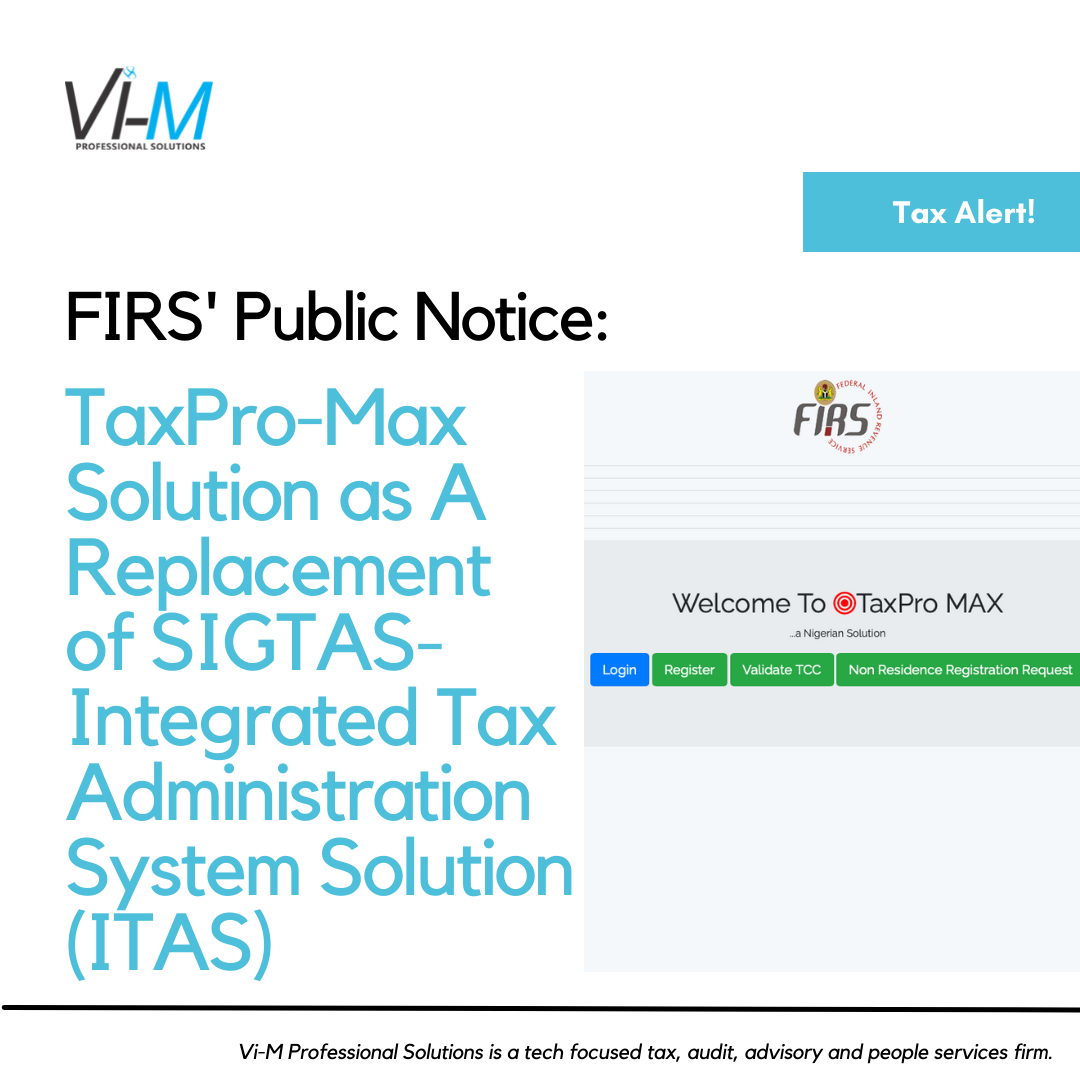
  • FIRS Public Notice: TaxPro-Max Solution as A Replacement of SIGTAS-Integrated Tax Administration System Solution (ITAS)

    FIRS Public Notice: TaxPro-Max Solution as A Replacement of SIGTAS-Integrated Tax Administration System Solution (ITAS)

    The Federal Inland Revenue Service (FIRS), has through its Public Notice of 8 February 2022, officially declared that the use of its originally developed digital platform for tax filing and administration – SIGTAS-ITAS Platform, had been discontinued.

    The TaxPro-Max – a new digital online platform developed in-house by the FIRS and deployed for public use in 2021 has now replaced the former system (SIGTAS-ITAS) following the full implementation of the TaxPro-Max solution.

    This clarification is important as many tax stakeholders still confuse or mistake the TaxPro-Max to be part of, or an extension or reformation of the ITAS platform.

    The FIRS by this Public Notice, is urging taxpayers to embrace and support the TaxPro-Max as it is expected to improve tax administration by easing the process of tax compliance, enhancing transparency, and providing convenience. The Service further assures the public that taxpayers’ data from the previous SIGTAS-ITAS have been securely and successfully migrated and archived in line with the FIRS’ data protection and privacy rules. 

    While the TaxPro-Max solution is a welcome development, the FIRS is encouraged to fix the system bugs and challenges which taxpayers have continued to encounter, e.g., intermittent downtimes, intermittent malfunction, cumbersomeness in filing of certain tax returns, non-activation/ non-inclusion of tax clearance processing functionality, erroneous/ duplicate assessments, non-reflection of actual period covered by some taxes being processed, etc.

    For more enquiries or help with using TaxPro-Max, please send ann email to us via clients@vi-m.com

  • FIRS Public Notice: Treasury Bills, Other Government Securities and Bonds Are No Longer Exempt from Companies’ Income Tax

    FIRS Public Notice: Treasury Bills, Other Government Securities and Bonds Are No Longer Exempt from Companies’ Income Tax

    Effective 2 January 2012, former President Goodluck Jonathan signed into law, the Companies Income Tax (Exemption of Bonds and Short-Term Government Securities) Order, 2011. This Act exempted the following instruments and interests earned from them, from companies’ income tax, for a period of 10 years:

    1. Short Term Federal Government of Nigeria Securities, such as Treasury Bills and Promissory Notes
    2. Bonds issued by Federal, State and Local Governments and their Agencies
    3. Bonds issued by corporate bodies including supra-nationals

    This 10-year exemption period recently expired on 1 January 2022. The 10-year period limitation did not apply to bonds issued by the Federal Government, which, according to the law, shall continue to enjoy such exemption.

    Recently, the Federal Inland Revenue Service (FIRS) also issued a Public Notice to remind the general taxpaying public, particularly companies that invest in treasury bills, bonds, and other government securities about the expiration of this tax exemption period. 

    Companies investing in treasury bills, bonds, and other government securities (apart from bonds issued by the Federal government) should please be aware of this expiration of income tax exemption and make adequate provision for the tax impact (including withholding tax at source) of these investments and any interests earned from them, from 2 January 2022.

  • Federal Ministry of Interior Issues Additional Guidelines for Administration of Expatriate Quota and Other Business Instruments in Nigeria.

    Federal Ministry of Interior Issues Additional Guidelines for Administration of Expatriate Quota and Other Business Instruments in Nigeria.

    The Federal Ministry of Interior (FMI or the Ministry) on Monday, 24 January 2022 issued a Public Notice to implement additional Guidelines for administration of Expatriate Quota (EQ) and other matters relating to business residency in Nigeria. These Guidelines became effective on the same date, 24 January 2022.

    Highlighted below are the key provisions of the Public Notice:

    1. Evaluation/ appraisal of continued eligibility for beneficiaries or holders of EQ positions granted on Permanent until Reviewed (PUR) status

    The Ministry is conducting a comprehensive appraisal of EQ positions granted on PUR status since the inception of the programme, to determine continued eligibility for its holders. During the appraisal, consideration will be given to the length of time the instrument has been held and the extent of utilization of each facility.

    To this end, companies granted EQ positions on PUR status by the Ministry are directed to submit copies of their certificates to the office of the Deputy Director, Enforcement, Investigation & Inspection of the Ministry between Monday, 24 January 2022 and Monday, 28 February 2022. EQ positions on PUR status not submitted by 28 February 2022 would be deemed to have lapsed and its validity withdrawn by the Ministry.

    • Mandatory online submission of monthly EQ Returns

    Effective 24 January 2022, manual submission of EQ returns at the Ministry is no longer allowed. Organisations with EQ positions are mandatorily required to submit their monthly EQ utilization returns online via www.ecitibiz.interior.gov.ng. The returns must contain the National Identity Number (NIN) of the expatriates and their Nigerian understudies.

    Note: Section 16 of the National Identity Management Commission (NIMC) Act defines registrable persons (for assignment of NIN) to include Nigerian citizens, permanent residents and foreigners who are legally resident in the country for a period of 2 years or more. Below is the list of requirements for expatriates to obtain a NIN:

    • International passport
    • Residence permit (CERPAC form / card)
    • Bank Verification Number (BVN)
    • Requirement for formal introduction of consultants/ representatives to the Ministry by organizations

    Effective from 24 January 2022, organizations holding EQ approvals and other certificates from the Ministry are required to formally write to introduce and submit details of their representative/ consultant to the Ministry through the Office of the Director, Citizenship and Business Department. The letter must contain the full name, position, official email address, official and alternative phone numbers (if any), mailing address, 2 recent passport photographs and official identity card of the consultant/ representatives.

    These Guidelines are expected to enable the Ministry achieve better operational effectiveness towards its objective of successfully regulating expatriate employment and related business operations in Nigeria.

    For further enquiries or for help with complying with any of these requirements, please send an email to clients@vi-m.com .