
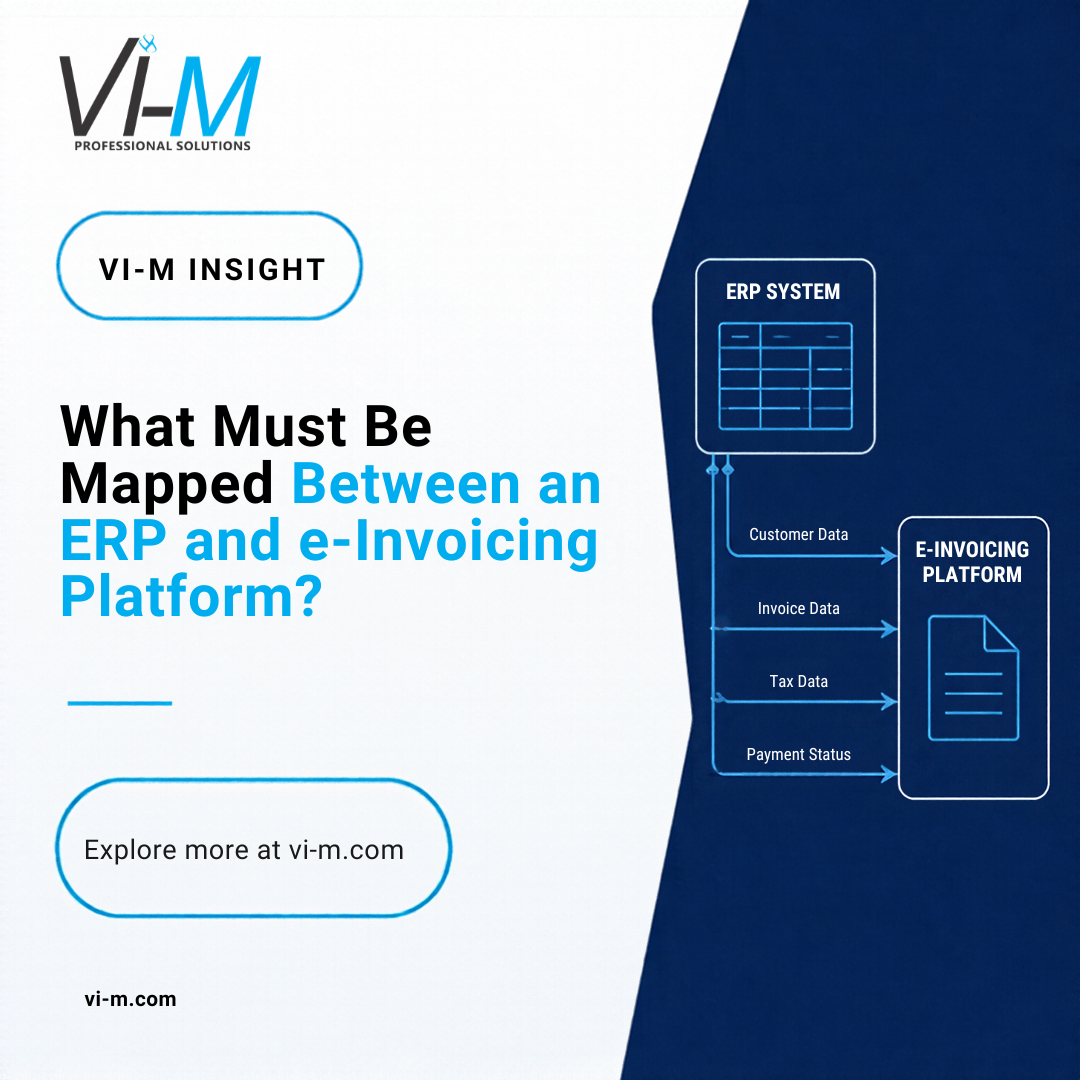

As businesses transition towards electronic invoicing, one important implementation question deserves attention: Can the information generated by an organisation’s existing ERP or accounting system be accurately interpreted, validated and transmitted through an e-Invoicing platform?
The answer depends on more than technical connectivity.
An ERP system may already generate invoices, calculate taxes and maintain customer records. However, this does not automatically mean its data structure and business processes meet the requirements of an electronic invoicing framework.
Successful integration requires careful mapping of the information exchanged between both systems.
What should businesses consider?
1. Customer and supplier information
Customer and supplier records must contain the identifiers and relevant details required for compliant electronic invoicing. Inaccurate registration details, incomplete addresses or inconsistent records may create validation or processing difficulties.
2. Products, services and transaction classifications
Different organisations maintain product and service information differently. Item descriptions, quantities, units of measurement and transaction classifications need to be mapped correctly to the applicable e-Invoicing structure.
3. Tax codes and calculations
An ERP’s internal tax codes do not necessarily correspond directly with the classifications required by an e-Invoicing platform.
VAT treatment, exemptions, applicable tax categories, discounts and invoice totals must be properly configured and validated to reduce the risk of incorrect reporting.
4. Invoice types and supporting references
Standard invoices, credit notes and other supported transaction documents may require different classifications and reference information.
Businesses must determine how document types, invoice identifiers, adjustments and links to earlier transactions are represented across both systems.
5. Currency and transaction values
Where transactions involve different currencies, the integration must correctly distinguish invoice currency, applicable tax currency and relevant transaction amounts.
Differences in rounding, exchange-rate treatment or calculation logic may create reconciliation challenges.
6. Invoice validation, status and error management
Integration does not end when invoice data leaves the ERP.
Businesses also need to understand how validation responses, submission failures, invoice statuses and corrections are communicated back to their internal systems.
Without appropriate monitoring and exception-handling procedures, unsuccessful transactions may remain unresolved while internal records suggest that invoicing has been completed.
Why this matters
Poor data mapping can result in rejected invoices, inaccurate tax reporting, duplicated transactions, operational delays and unnecessary manual intervention.
A well-designed integration should therefore reflect not only the technical specifications of the e-Invoicing platform but also the organisation’s actual invoicing processes, tax obligations and internal controls.
The starting point is not simply whether two systems can communicate. It is whether they can exchange accurate information, interpret it consistently and maintain reliable transaction records.
How Vi-M supports businesses
At Vi-M Professional Solutions Limited, we bring together tax and regulatory advisory, enterprise systems knowledge and digital integration capabilities to help organisations assess their readiness, identify mapping gaps and develop practical e-Invoicing integration approaches.
Our focus is on connecting regulatory requirements with the systems and processes businesses already depend on.
Learn more: www.vi-m.com
Explore our e-Invoicing solution: www.envoice.ng