

Meeting new digital compliance requirements does not always mean replacing the systems your business already relies on.
As businesses adapt to Nigeria’s electronic invoicing requirements, one concern may arise: Will our existing ERP or accounting system need to be replaced to meet the new requirements?
For organisations that have invested significantly in their financial systems, replacing or extensively modifying an ERP can be costly and disruptive.
An ERP may already manage accounting, invoicing, inventory and financial reporting effectively. However, it may not be designed to communicate directly with a new electronic invoicing platform.
This does not necessarily mean the ERP is outdated or inadequate. Sometimes, the challenge is simply getting two systems to communicate correctly.
That is where middleware can help.
What Is Middleware, and Why Does It Matter?
Middleware is software that connects different applications, allowing them to exchange information without requiring major changes to their existing structures.
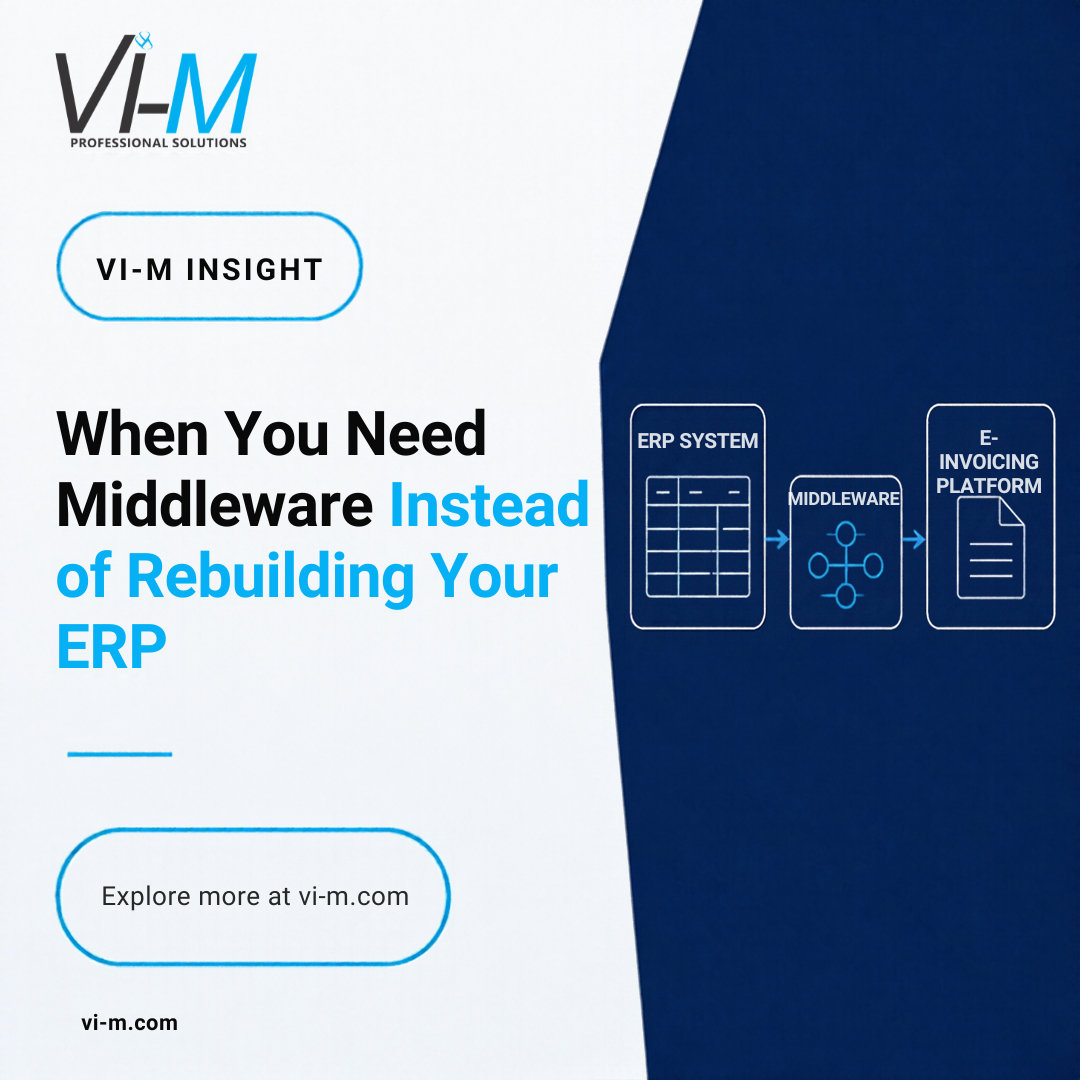
Consider a business whose ERP generates invoices using its established accounting procedures. The e-Invoicing platform, however, requires invoice information in a particular format.
Rather than rebuilding the ERP, middleware can act as a bridge between both systems.
It can retrieve invoice information, convert it into the required format and facilitate transmission to the e-Invoicing platform. Depending on its capabilities, it can also help monitor invoice processing and communicate errors or responses back to the ERP.
The ERP continues to manage the business’s core financial activities, while middleware helps it communicate with the external platform.
This distinction is particularly important when businesses are evaluating the cost and complexity of digital compliance.
When Does Middleware Make Business Sense?
1. When the Existing ERP Still Works Well
A new regulatory requirement does not automatically make an existing ERP obsolete.
If the system already supports accounting, invoicing and reporting effectively, replacing it solely to achieve e-Invoicing connectivity may be unnecessary.
Where the ERP can reliably provide the required information, middleware may offer a more practical way to connect it to an electronic invoicing platform.
2. When Direct Integration Requires Extensive ERP Changes
Some ERP systems may require considerable customisation to communicate with external platforms.
Such modifications can affect existing workflows, require additional testing and create maintenance challenges when the ERP is upgraded.
Middleware may reduce the need for extensive changes by handling certain data conversion and communication requirements outside the core ERP.
This can make integration easier to manage, although the middleware itself must still be properly secured, tested and maintained.
3. When a Business Uses Multiple Financial Systems
Larger organisations sometimes operate different ERP or accounting systems across subsidiaries, departments or locations.
Connecting each system separately to an e-Invoicing platform may create additional development and maintenance work.
Middleware can provide a common integration framework, helping information from different systems reach the required platform in a consistent manner.
Each system will still require appropriate data mapping and testing, but a coordinated integration approach may reduce unnecessary duplication.
4. When External Requirements Are Likely to Change
Digital compliance requirements and technical specifications may evolve.
Where an ERP has been extensively customised for a particular external requirement, future changes could involve further modifications to the core system.
Middleware can help manage certain changes within the integration layer instead.
This may reduce the impact on existing ERP processes and make ongoing maintenance more manageable.
Does Every Business Need Middleware?
Not necessarily. Some ERP systems already have suitable integration features, supported connectors or APIs that allow them to communicate directly with e-Invoicing platforms.
In such cases, adding middleware may introduce unnecessary cost and complexity.
Similarly, middleware cannot correct fundamental weaknesses in an ERP, inaccurate accounting records or incorrect tax treatment.
The decision should therefore be based on what the business actually needs, not simply on the availability of another technology solution.
What Should Businesses Consider Before Deciding?
Before investing in middleware, ERP customisation or a replacement system, organisations should ask a few practical questions:
- Is the existing ERP performing its core functions effectively? If yes, replacement may not be necessary.
- Can the ERP connect directly to the required platform? Existing connectors or APIs may already provide a workable solution.
- Would integration require extensive changes? Consider the cost, disruption and maintenance implications of each option.
- Are the underlying invoice data and tax treatments accurate? Connectivity alone cannot resolve poor data quality or incorrect classifications.
- Who will manage the integration? Monitoring, error resolution, system security and reconciliation must have clear ownership.
A careful review of these questions can help organisations choose a solution that meets their compliance requirements without unnecessary expenditure or disruption.
How Vi-M Supports Businesses
At Vi-M Professional Solutions Limited, we understand that successful digital compliance requires more than installing software.
It involves understanding how business transactions are processed, how tax requirements apply and how financial systems can communicate reliably with regulatory platforms.
By combining tax and regulatory advisory with enterprise systems knowledge and digital integration capabilities, we support organisations in evaluating their existing systems, identifying integration gaps and determining practical approaches to e-Invoicing implementation.
Our focus is on helping businesses adopt technology that addresses genuine operational and compliance needs.
Conclusion: Make Existing Systems Work Better
New digital compliance requirements do not always call for new enterprise systems.
Where an existing ERP remains effective, improving its ability to communicate with external platforms may be more appropriate than replacing it.
Middleware can provide that connection in suitable circumstances, but it should be selected only after reviewing the organisation’s requirements, available system capabilities and implementation risks.
The objective is not to introduce more software. It is to make business systems work together more effectively, reliably and securely.
Vi-M Professional Solutions Limited
Advisory depth. Technology capability. Enterprise perspective.
Learn more about our advisory and digital integration capabilities: https://vi-m.com
Explore our e-Invoicing solution: https://envoice.ng