

Understanding where Nigeria’s new tax laws meet everyday business operations
A business may understand the new tax rates and still be unprepared for tax reform. Why? Because compliance begins long before a tax return is filed.
Nigeria’s 2025 Tax Reform Acts have introduced significant changes to the country’s tax framework. Since their implementation in 2026, businesses have had to consider new tax rules, revised compliance obligations, evolving administrative procedures and the increasing role of technology in tax reporting.
For many organisations, the immediate response has been to study the new laws, review tax rates and understand applicable exemptions. These are important steps, but they represent only part of the preparation required.
The more practical question is: How do these changes affect the way the business operates, records transactions, manages its systems and meets its tax obligations?
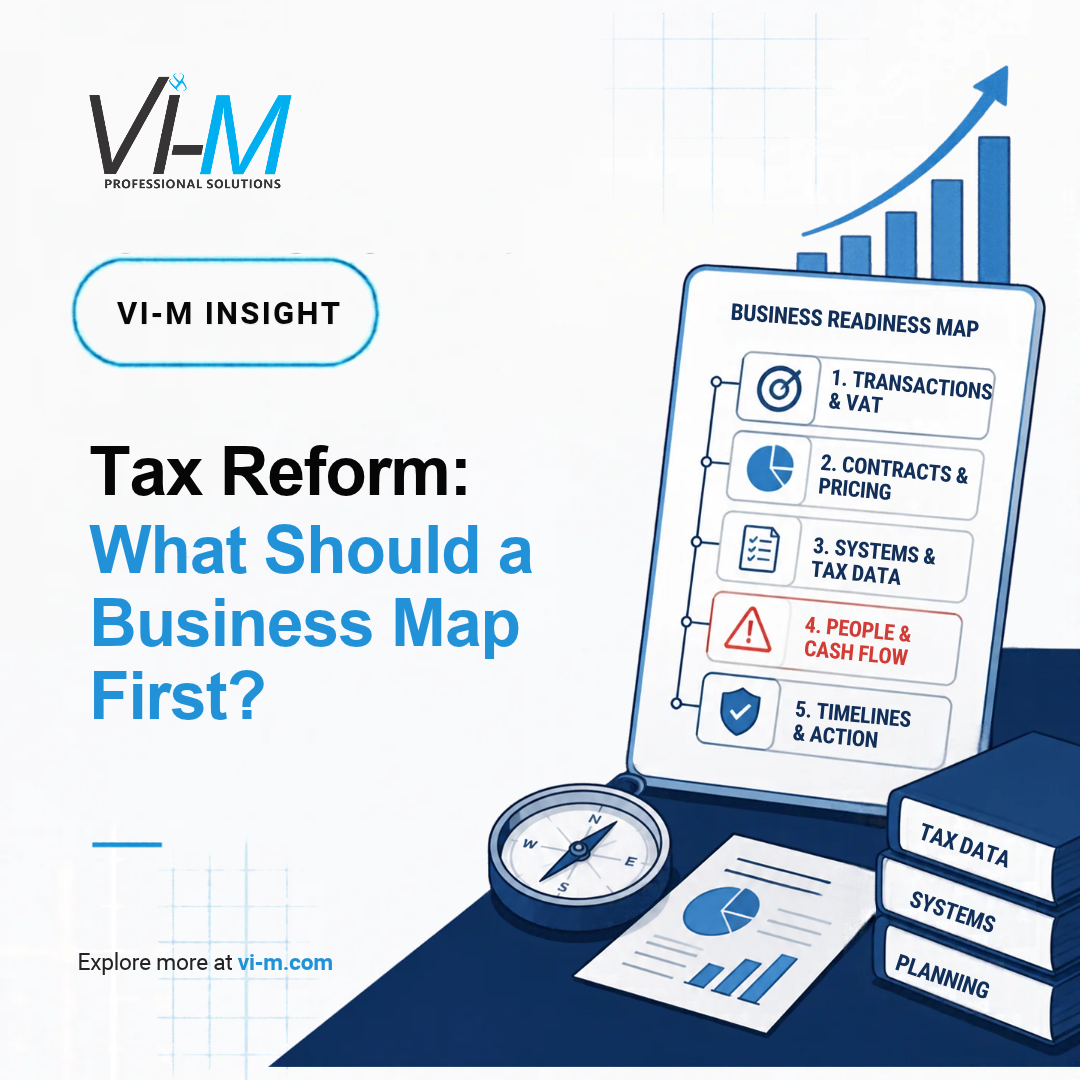
A useful starting point is tax reform mapping—identifying the areas of the business affected by the new laws, assessing existing processes and determining what needs to change.
This does not necessarily require an expensive technology overhaul or a lengthy transformation project. It begins with understanding the business itself.
1. Start With the Transactions: What Does the Business Actually Do?
Before reviewing tax computations, a business should understand the transactions that generate its income and expenses.
Consider a company that sells equipment, provides installation services and offers annual maintenance contracts. Although these activities may appear together in its financial statements, they could have different tax implications.
The business needs to establish:
- What goods and services it sells or purchases.
- Whether transactions are local, cross-border or between related parties.
- Which transactions attract VAT, withholding tax or other applicable taxes.
- Whether exemptions, zero-rating provisions or special treatments apply.
- When transactions occur and how they are recorded.
Why does this matter?
An incorrect tax treatment at the point of sale can affect invoicing, pricing, customer payments and statutory reporting.
For example, treating a zero-rated supply as exempt could affect the business’s ability to recover qualifying input VAT. Similarly, applying withholding tax incorrectly could create unnecessary cash-flow pressure or reconciliation difficulties.
The objective is to understand the tax treatment of each significant transaction category before it enters the accounting and reporting process.
2. Map Revenue Streams, Products and Services
Not every source of revenue should automatically receive the same tax treatment.
A business may earn income from product sales, consultancy, subscriptions, commissions, licensing arrangements, rentals or exports. Each revenue stream should be reviewed against the applicable provisions of the new tax laws.
This is particularly important under the revised VAT framework, which retains the 7.5% standard rate while expanding the treatment of certain zero-rated supplies and qualifying input VAT recovery.
Businesses should therefore examine how their products and services are classified, whether the correct tax codes are applied and whether their invoicing systems can distinguish between different tax treatments.
For businesses offering bundled products and services, it may also be necessary to determine whether separate components require different tax classifications.
The practical goal is simple: Every product or service should have an identifiable and supportable tax treatment that can be consistently applied across the business.
3. Review Contracts and Business Arrangements
Tax reform can affect existing commercial arrangements, not just future transactions.
Contracts signed before the commencement of the new laws may remain operational for several years. However, transactions performed under those contracts may be subject to different tax rules depending on the relevant dates and transitional provisions.
Businesses should review contracts to identify:
- Tax clauses and responsibility for applicable taxes.
- Pricing arrangements and whether taxes are included or excluded.
- Withholding tax obligations.
- Cross-border payments and related-party arrangements.
- Contract commencement dates, delivery milestones and payment terms.
For instance, a contract signed in 2025 but performed partly in 2026 may require careful consideration of the transition rules.
The Federal Ministry of Finance’s General Transition Guidelines provide guidance on the treatment of transactions spanning the old and new tax regimes.
The important distinction is that the date a contract was signed does not, by itself, determine the tax treatment of every transaction performed under it.
Contract reviews can help businesses identify potential tax exposures, avoid disputes with customers and suppliers, and determine whether amendments or operational adjustments are necessary.
4. Assess the Systems That Capture and Process Tax Information
One of the most significant operational aspects of Nigeria’s tax reforms is the growing connection between taxation and technology.
Traditionally, many businesses treated tax compliance as an exercise undertaken after transactions had already been recorded. Finance teams extracted figures from accounting records, prepared computations and submitted returns.
With the introduction of electronic invoicing and increasingly digital tax administration, this approach requires reconsideration.
Tax information is becoming more closely connected to the original transaction and the systems through which it is processed.
Businesses should therefore assess their accounting software, Enterprise Resource Planning (ERP) systems, invoicing applications, payroll systems and reporting tools.
Key considerations include whether these systems can:
- Apply the appropriate tax treatment to transactions.
- Capture the information required for compliant invoices.
- Support applicable NRS e-invoicing requirements.
- Integrate with relevant tax reporting platforms.
- Produce accurate and reconcilable tax reports.
For example, a business may have an accounting system that generates invoices but lacks some of the structured data required for electronic invoice submission.
In such circumstances, compliance may require configuration changes, data improvements, integration with an approved solution provider or other suitable arrangements.
Importantly, not every business requires the same technology solution. The appropriate approach depends on its size, transaction volume, existing systems and applicable implementation timeline.
The objective should be to make existing processes compliant and efficient, rather than introduce technology for its own sake.
5. Examine Tax Data Quality and Governance
Even the most sophisticated accounting or invoicing system depends on the quality of the information entered into it.
Incomplete customer records, incorrect Tax IDs, inconsistent product classifications or poorly maintained transaction records can undermine otherwise well-designed compliance processes.
Businesses should therefore assess the completeness, accuracy and consistency of their tax-related information.
Important categories include taxpayer identification details; customer and supplier records; product and service classifications; invoices and transaction records; payroll information; tax computations; and statutory filing records.
The next consideration is governance: Who maintains this information? Who verifies its accuracy? Who approves changes? Can the business reconcile the information across its accounting, invoicing and tax reporting systems?
For example, where sales figures in the general ledger differ from amounts reported through invoicing systems or VAT returns, the business should be able to explain and reconcile those differences.
Good tax data governance means having reliable information, clear ownership and an audit trail that supports the business’s tax position.
As digital reporting becomes more integrated into tax administration, these controls will become increasingly important.
6. Identify the People and Departments Affected
Tax reform readiness cannot be the responsibility of the Tax Department alone.
Consider how different teams contribute to compliance.
Sales teams negotiate prices and initiate customer transactions. Procurement teams manage supplier arrangements. Human Resources maintains payroll information. IT supports the systems that capture and transmit data. Finance records transactions and prepares reports.
An error at any stage can eventually become a tax compliance issue.
Businesses should therefore identify which departments are affected, what each team needs to understand and where responsibilities overlap.
Equally important is having a designated person or coordinating team capable of interpreting the requirements and translating them into practical actions across departments.
Without this coordination, Finance may understand the tax treatment while IT remains unaware of the required system changes, or Sales may continue using outdated invoice templates.
Effective readiness requires a shared understanding of the rules and clear accountability for implementing them.
7. Evaluate the Financial and Cash-Flow Implications
Tax reform mapping should also consider the financial consequences of compliance.
Changes in tax treatment, deductions, input VAT recovery, payroll taxation and reporting obligations can affect business costs and cash flow.
For example, the revised VAT framework provides broader opportunities for recovering qualifying input VAT on business purchases, including certain services and capital assets. However, the benefit depends on the nature of the business’s supplies and its ability to satisfy the relevant requirements.
Businesses should assess whether the reforms affect:
- Product pricing and profit margins.
- Tax provisions and financial forecasts.
- Withholding tax credits and recoveries.
- VAT payments and input VAT claims.
- Payroll costs and employee take-home pay.
- Technology implementation and compliance expenditure.
This analysis helps management distinguish between actual increases in tax liability, changes in payment timing and the costs of implementing new compliance processes.
It also allows businesses to budget realistically for necessary adjustments.
8. Understand the Transition: Which Rules Apply and When?
A particularly important aspect of the reforms is the transition from the former tax laws to the new framework.
The General Transition Guidelines issued by the Federal Ministry of Finance address matters including accounting periods, transactions spanning both regimes, existing incentives, filing obligations and the prevention of retrospective taxation.
For businesses, this means establishing which rules apply to particular transactions and accounting periods rather than assuming that every filing made in 2026 must be calculated entirely under the new provisions.
For instance, a company with an accounting period ending before the commencement of the new framework may have different income tax treatment from one whose accounting period ends afterwards.
Similarly, goods delivered or services rendered before commencement may require different transaction-tax treatment from supplies made under the new regime.
Businesses should also monitor NRS information circulars, administrative notices and e-invoicing implementation schedules, as these provide further operational guidance.
The practical requirement is to maintain a clear record of relevant dates, transactions and applicable provisions.
A transition calendar can help prevent businesses from applying the correct tax rule to the wrong period.
9. Turn the Mapping Exercise Into an Action Plan
Once the relevant business activities, systems, people and obligations have been identified, the next step is to convert the findings into a workable implementation plan.
This need not be complicated.
A practical tax reform readiness plan should identify each compliance requirement, the affected business process, the required action, the responsible person and the implementation deadline.
For example:
| Area | Practical action | Responsible function |
|---|---|---|
| Transactions and VAT | Review tax treatment and classifications | Finance / Tax |
| Contracts | Assess tax clauses and transitional implications | Legal / Finance |
| Invoicing and ERP | Evaluate system readiness and integration needs | IT / Finance |
| Tax data | Validate records and reconciliation processes | Finance / IT |
| Payroll | Review PAYE calculations and employee data | HR / Payroll |
| Compliance reporting | Update filing procedures and calendars | Tax / Finance |
| Oversight | Monitor implementation and resolve gaps | CFO / Management |
The plan should distinguish between immediate compliance requirements, medium-term system improvements and longer-term capacity-building initiatives.
It should also be reviewed as additional administrative guidance becomes available.
This approach makes the transition manageable, particularly for small and medium-sized businesses that may not have dedicated tax or technology departments.
The Bigger Picture: Tax Reform Is Also an Operational Readiness Exercise
Nigeria’s new tax framework is changing more than the rules used to calculate tax liabilities. It is increasing the importance of accurate transaction records, reliable systems, coordinated business processes and timely reporting.
A business may have correctly interpreted the law but still face compliance difficulties if its invoices are incomplete, its data is inconsistent or its departments are working independently.
Conversely, a business that understands its transactions, maintains reliable records and establishes clear responsibilities is better positioned to adapt as requirements evolve.
Tax reform mapping is therefore not about reviewing every provision of the law at once. It is about identifying where the law intersects with the business and taking deliberate steps to close the gaps.
Where Should a Business Begin?
A useful starting point is to ask three questions:
What has changed? Identify the provisions and administrative requirements relevant to the business.
Where does the change affect operations? Trace the impact across transactions, contracts, people, systems, reporting and cash flow.
What needs to be done, by whom and when? Establish responsibilities, priorities and a realistic implementation roadmap.
The earlier these questions are addressed, the easier it becomes to move from reacting to tax obligations towards managing compliance as part of normal business operations.
How Vi-M Professional Solutions Can Support the Transition
At Vi-M Professional Solutions Limited, our approach to tax reform readiness combines tax and regulatory advisory with practical implementation support.
We assist businesses in assessing their tax obligations, reviewing operational and data readiness, evaluating e-invoicing requirements, supporting ERP and tax technology integration, and developing practical compliance processes.
Our focus is to help organisations translate regulatory requirements into workable business solutions, with due consideration for their size, existing infrastructure and operational priorities.
Tax reform readiness begins with understanding the business. Sustainable compliance comes from aligning the law, the people, the processes and the technology.
Vi-M Professional Solutions Limited
Powering Digital Tax Systems, Regulatory Compliance, Governance & Enterprise Infrastructure.
Explore more at www.vi-m.com