
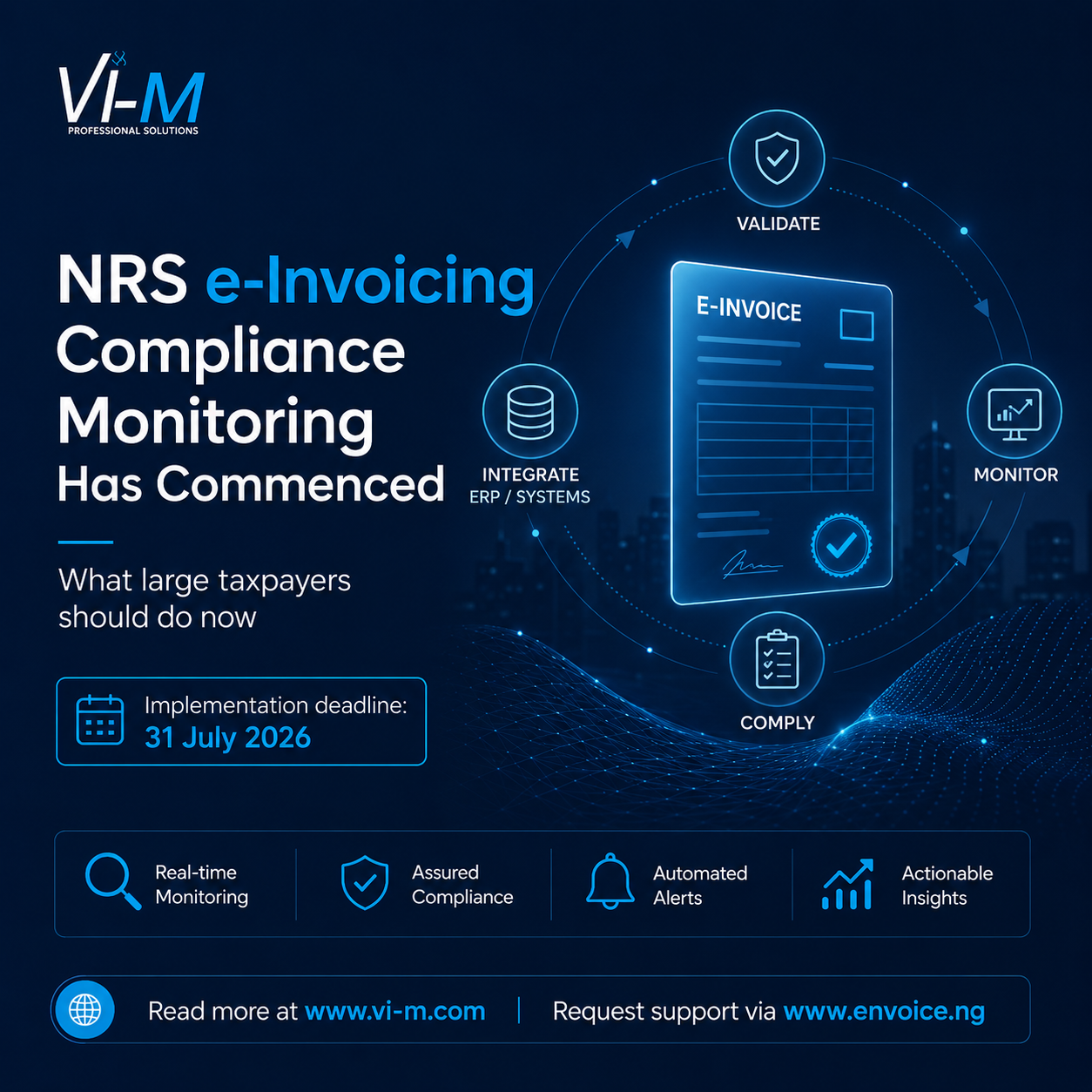

The Nigeria Revenue Service has commenced compliance monitoring for large taxpayers under the National e-Invoicing and Electronic Fiscal System, also known as the Merchant Buyer Solution (MBS).
The NRS set 31 July 2026 as the deadline for affected large taxpayers to complete implementation. That deadline has now passed.
For businesses that have not commenced implementation, have only partially implemented, or are yet to commence active invoice transmission, the priority should now be to identify outstanding gaps and move quickly towards operational compliance.
What Does Compliance Require?
The NRS has indicated that compliance goes beyond simply registering on the platform.
Affected taxpayers are expected to have:
- completed onboarding on the NRS Merchant Buyer Solution;
- integrated relevant systems through approved System Integrators and/or Access Point Providers;
- completed required validation and testing;
- commenced active transmission of invoices to the NRS e-Invoicing platform; and
- established processes for receiving compliant supplier invoices with valid Invoice Reference Numbers.
The key question is therefore no longer simply “Have we started?”
It is: “Is our e-Invoicing process operational, tested and capable of supporting ongoing compliance?”
Questions Large Taxpayers Should Be Asking Now
Businesses should confirm:
- Is NRS onboarding complete?
- Has an approved SI and/or APP been selected?
- Is the ERP, accounting system or invoicing process properly integrated?
- Have mapping, validation and testing been completed?
- Can invoices be transmitted successfully to the NRS platform?
- Can the business issue and receive compliant e-Invoices with valid IRNs?
- Are credit notes and debit notes properly handled?
- Are payment updates and invoice status changes being captured?
- Is there adequate visibility, audit trail and user control around the process?
Where any of these remain outstanding, the business should treat them as immediate implementation priorities.
e-Invoicing Is More Than an IT Project
National e-Invoicing affects tax, finance, operations, technology, governance and supplier/customer processes.
Successful implementation therefore requires more than connecting an API.
Businesses need to consider:
Invoice Data
Accuracy, completeness and consistency of transaction information.
Tax & Classification
VAT treatment, invoice types, product/service classifications and related tax data.
Systems Integration
ERP, accounting software, billing platforms, APIs and middleware.
Governance & Controls
User access, approval processes, audit trails, invoice status and exception management.
Operational Readiness
Training, supplier/customer processes, testing, ongoing support and compliance monitoring.
The objective should be to embed e-Invoicing into the normal transaction process rather than operate it as a separate compliance exercise.
How Vi-M and eNvoice Can Support
Vi-M Professional Solutions Limited is accredited within the national e-Invoicing ecosystem as both a System Integrator (SI) and an Access Point Provider (APP).
Through eNvoice, we support businesses with practical e-Invoicing readiness, implementation, integration and ongoing compliance.
Our support includes:
- e-Invoicing readiness and gap assessment;
- NRS onboarding support;
- ERP and accounting-system integration;
- invoice-data mapping and validation;
- SI, APP and SI + APP implementation pathways;
- API and middleware integration;
- IRN, QR, signing and transmission workflows;
- credit and debit note processing;
- payment-status handling;
- invoice-status monitoring;
- user training; and
- post-implementation compliance support.
Businesses without an existing ERP or accounting platform can also use eNvoice as a lightweight invoicing and compliance workspace.
For SI-Only Providers
System Integrators that do not operate their own Access Point infrastructure can use eNvoice APP connectivity to support their clients while concentrating on implementation and systems integration.
What Should Affected Businesses Do Now?
Where implementation is incomplete, businesses should immediately:
Assess → Close Gaps → Integrate → Test → Transmit → Monitor
The focus should now be on achieving an operational process that can support ongoing e-Invoicing compliance, not merely completing registration.
Need to Review Your e-Invoicing Readiness?
For an e-Invoicing readiness discussion, implementation support, APP connectivity or an eNvoice demonstration, visit:
For Vi-M’s broader tax, regulatory, technology, enterprise systems, governance and professional services:
Vi-M Professional Solutions Limited
Powering Digital Tax Systems, Regulatory Compliance, Governance & Enterprise Infrastructure