On December 5, 2023, the Corporate Affairs Commission (CAC) issued a Public Notice informing the public about its commencement of implementing a minimum paid-up capital requirement of N100,000,000 for companies with foreign equity participation.
After a period of uncertainty surrounding whether incorporation requirements for companies with foreign equity participation would change, the CAC has now synchronized its minimum paid-up capital requirement for such companies with the provisions of the Revised Handbook on Expatriate Quota Administration.
Furthermore, the CAC mandates existing companies with foreign participation, possessing less than N100,000,000 in paid-up capital, to meet the new capital requirement within 6 months from the date of the Notice (5 December 2023).
Failure to comply will result in the CAC initiating compulsory winding-up proceedings for companies still in default of the minimum paid-up capital requirement after the 6-month grace period.
For more enquiries about how this new requirement would impact your business in Nigeria, or to seek professional support, please do not hesitate to send us an email via clients@vi-m.com.
The Finance Act 2020, which came into effect on 1st January 2021, amended Section 18(1) of the Nigeria Export Processing Zones Authority (NEPZA) and Oil and Gas Free Zone Authority (OGFZA) Acts respectively, to make it a statutory requirement for enterprises within the respective zones to file income income tax returns, albeit no income tax is payable.
On this backdrop, the Federal Inland Revenue Service (FIRS) has recently issued a Public Notice, to serve as a guide for enterprises in the Zones to file the required income tax returns.
The Notice stipulates as follows:
The NEPZA Act and OGFZA Act (as amended) mandate all enterprises registered and operating in the zones to file income tax returns in accordance with the provisions of the Companies Income Tax Act (CITA).
As such, all enterprises registered and operating in the zones are required: a. to file income tax returns for 2021 and subsequent years of assessment; and b. to compute income tax and pay the tax due (if any). The returns should be in the manner and time specified by CITA.
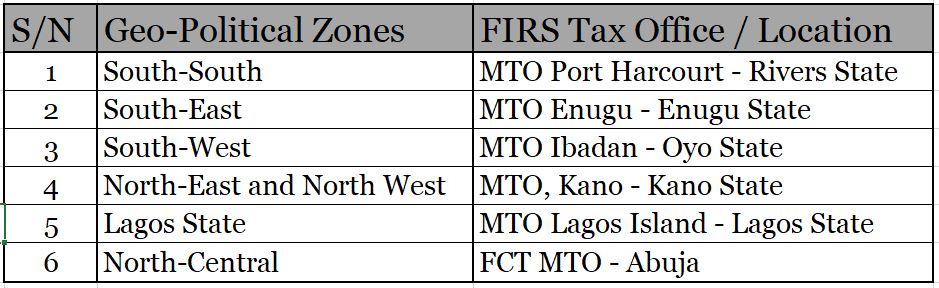
For ease of compliance, all approved enterprises are required to file their income tax returns at the following FIRS’ tax offices: a. Enterprises operating in the Zones located in South-South Geo-political region of Nigeria- MTO Port Harcourt; b. Enterprises operating in the Zones located in South-East Geo-political region of Nigeria- MTO Enugu; c. Enterprises operating in the Zones located in South-West Geo-political region of Nigeria- MTO Ibadan; d. Enterprises operating in the Zones located in North-East and North-West Geo-political region of Nigeria- MTO Kano; e. Enterprises operating in the Zones located in Lagos State- MTO Lagos Island; and f. Enterprises operating in the Zones located in North-Central Geo-political region of Nigeria and FCT- MTO Abuja.
Relevant penalties prescribed by CITA or Federal Inland Revenue Service (Establishment) Act 2007 shall apply to any company that fails to comply with the filing requirements as regards due dates.
This Notice provides the much needed clarity as to the Expectations of the FIRS, regarding how free trade zone enterprises are to comply with the new amendments to the NEPZA and OGFZA.
For further enquiries or help with filing the income tax returns, please send an email to clients@vi-m.com.
On 29th March 2021, the FIRS issued a notice to the general public, taxpayers and tax practitioners to cater for the clarification on tax payment in instalments by self-assessment filers as approved by the Finance Act, 2019.
Section 18 of the Finance Act, 2019 which amended Section 77 (5) of the Company Income Tax Act (CITA), cap C21 LFN 2004 states that:
“(5) Every Company shall make payment of tax due on or before the due date of filing in one lump sum or in instalments, provided that: where the taxpayer pays in instalments –
The taxpayer shall first write, with evidence of payment of the first instalment, and obtain the approval of the service to pay in such number of instalments as may be approved by the service; and
The final instalment must be paid on or before the due date of filing.”
(5b) Any balance of taxes unpaid as at the due date shall attract interest and penalties as provided in the Act or any other relevant law for failure to pay on the due date in accordance.”
The notice according to the FIRS, elucidates on the section above stating that “Any Company that wishes to pay by instalments must have applied in writing, before the due date of filing, attaching evidence of full payment of Tertiary Education Tax (TEDT) and first instalment of the Companies Income Tax (CIT) due. It is important to note that the last instalment must be paid on or before the due date for filing tax returns, otherwise penalty and interest will be charged after the due date.”
All taxpayers have been charged to ensure compliance with the aforementioned provisions of the Act as failure to comply attracts the measures for the recovery of tax as enshrined in Section 85 (1) of CITA cap C21 LFN 2004 as amended and Section 32 of FIRS Establishment Act (2007), which authorize addition for non-payment and enforcement of payment.
FIRS reaffirms that tax offices will provide adequate assistance to tax payers to satisfy the requirements of the Finance Act, 2019 as regards payments by instalment.
Click here to view the FIRS Publication.
For further clarifications or professional assistance in connection to this subject or any other matter, please contact Vi-M Professional Solutions on clients@vi-m.com or www.vi-m.com.
The Federal Inland Revenue Service (FIRS) on 30th March 2021, gave a notice which is in harmony with the provisions of Section 25(4) of the Federal Inland Revenue Service Establishment Act 2007 as amended by section 51 of Finance Act 2019.
This notice was addressed to the general public, tax practitioners and, particularly, all taxable persons (including individuals, trustees, partnerships, companies, corporations, etc.) as follows:
The Federal Inland Revenue Service (the FIRS) shall, not earlier than 30 days from the date of publication of this notice, begin to connect its Automated Tax Administration System to access, for tax purposes, relevant records, data or information stored or otherwise residing in computers or other electronic devices (including cloud computing facilities) maintained, operated, controlled or owned by relevant persons or their agents.
The connection shall include relevant point of sales or invoicing platforms of all taxable persons (individuals, enterprises, companies and entities).
Relevant persons are required to grant FIRS access to all computers, electronic devices or cloud computing facilities wherein records, data or information are stored or otherwise residing (Section 26, FIRS Act).
The attention of the tax paying public is drawn to the penalties prescribed in Section 26(3) of the FIRS Establishment Act for Failure to grant the necessary access.
To find out about the relevant taxes in Nigeria, which FIRS can specifically track with automated solutions, please visit our ebook store. To find out all about VAT and how it works in Nigeria, please refer to our ebook on ‘Value Added Tax Explained‘.
For further clarifications or professional assistance in connection to this subject, please contact Vi-M Professional Solutions on clients@vi-m.com or www.vi-m.com.
The amendment to the Capital Gains Tax Act, by the Finance Act 2020 mandates every person who disposed a chargeable asset to compute the Capital Gains Tax, file self-assessment returns and pay the tax computed thereon. This amendment came into effect from 1st January 2021.
Hence, the FIRS has issued a notice on 31st March 2021 to all taxpayers (companies, partnership, executors, trustees, community, families or individuals), tax practitioners and the general public as follows:
The Capital Gains Tax Act (CGTA) (as amended) mandates every person who disposes a chargeable asset to bi-annually compute the Capital Gains Tax, file self-assessment returns and pay the tax computed, in respect of the chargeable assets disposed, to the relevant tax authority.
The due date of filling for Capital Gains Tax returns and payment of Capital Gains Tax is the earlier of 30th June and 31st December immediately following the disposal.
As such, any taxpayers having disposed a chargeable asset is required to compute the Capital Gains Tax, file self-assessment return and pay the tax in respect of the following chargeable assets:
a. Chargeable assets disposed from 1st January in a year to 30th June of that year, not later than 30th June
b. Chargeable assets disposed from 1st July to 31st December each year, not later than 31st December
c. Chargeable assets disposed prior to the coming into effect of Finance Act 2020, not later than 30th June 2021
FIRS cautions that any tax due and unpaid by the due date shall attract interest and penalties as provided in the enabling legislation.
For further clarifications or professional assistance in connection to this subject, please contact Vi-M Professional Solutions on clients@vi-m.com or www.vi-m.com.
The Federal Inland Revenue service (FIRS) on the 30th of March 2021, issued a public notice in accordance with Section 18 (1) of the Nigeria Export Processing Zones Authority (NEPZA), and the Oil and Gas Free Zone Authority (OGFZA) Acts as amended by section 58 and 59 of the Finance Act 2020, which came into effect 1st January 2021.
The notice has been given by the FIRS to all enterprises registered and operating in the Nigeria Export Processing and Oil & Gas Free Zones (the zones), tax practitioners and the general public asserting that:
The NEPZA Act and OGFZA Act (as amended) mandates all enterprises registered and operating in the zones to file income tax returns in accordance with the provisions of the Companies Income Tax Act (CITA).
Hence, all enterprises registered and operating in the zones are required to:
to file income tax returns for 2021 and subsequent years of assessment; and
to compute income tax and pay the tax due (if any)
The returns should be in the manner and time as specified by CITA.
To allow for ease of compliance, FIRS has further highlighted / directed that enterprises operating in the relevant “Geo-Political Zones” are required to file their income tax returns in the respective FIRS offices as indicated below:
The publication also reiterates that relevant penalties prescribed by CITA or Federal Inland Revenue Service (Establishment) Act of 2007 shall apply to any company that fails to comply with the filing requirements as regards due dates.
For further clarifications or professional assistance in connection with your filing requirements, please contact Vi-M Professional Solutions on clients@vi-m.com or www.vi-m.com.
Stamp Duty (SD) is a type of tax that is applicable on the execution of certain instruments and special documents. For example, Receipts, Agreements, Contracts, Title deeds etc., to give it additional legal backing and enforcement in the event of dispute or presentation at a court of law, to make it enforceable.
Stamp Duty Act (SDA) is an Act to provide for the levying of stamp duties on certain matters / documents. It is the Act that gives the enabling government agency (Federal Inland Revenue Services (FIRS) for all federal related transactions and the State Internal Revenue Services (SIRS) for all state related transactions).
It therefore means that the first starting point for anyone or businesses is to determine if an instrument is liable to SD and thereafter to which tax authority – to the FIRS or to the SIRS.
It is also important to note that the existence of the SDA preexists Nigeria’s independence and as such it is here to stay, following the renewed efforts, commitment and focus by the FIRS and in view of the huge internally generated revenue that is attributable to this tax type.
It is on record also, that the total amount of SD collected for the calendar year 2019 is about NGN18billion, while for the first five (5) months (January to May) of 2020 the agency has recorded about NGN66billion in revenue.
CHANGES / REMINDERS TO THE GENERAL PUBLIC:
The FIRS is the competent authority to charge and collect SD upon instruments relating to transactions or matters executed between corporate bodies or between a corporate body and an individual, group or body of individuals, while the relevant SIRS shall collect SD in respect of instruments executed between individuals at such rate to be imposed or charged in agreement with the Federal Government.
Following the huge revenue attributable to this tax type and the changes in the Finance Act 2019 (which broadens the scope / complexity of this tax type), the FIRS has introduced and clarified the following as liable to SD:
All written / printed dutiable instruments or receipts
All electronic dutiable instruments or receipts (i.e. in the form of electronic media content, electronic documents or files, e-mails, short message service (sms), instant messages (IM), any internet-based messaging service, website or cloud-based platform, etc.)
All printed receipts (including POS receipts, physicalized device receipts, Automated Teller Machine (ATM) print-outs and other forms of written or printed acknowledgment)
All electronically generated receipts and any form of electronic acknowledgement of money for dutiable transactions
The FIRS issued a comprehensive Information Circular in May 2020, to explain and clarify the practical implications of the provisions of the Finance Act, 2019, regarding SD. This Information Circular can be found and downloaded here.
FIRS had also developed and launched an online portal “Integrated Stamp Duty Services” to support the activities of the agency. This portal – https://stampduty.gov.ng/ affords closer interactions, payments and issuance of stamp duties certificates / receipts to the taxpayer right from this platform.
For ease of administration, there are basically two (2) types of stamp duty payments. The fixed rate and the Ad Valorem rate (a percentage of the value indicated on the instrument to be stamped).
Historically, Stamp Duties were chargeable on only physical instruments but with the advent of the Finance Act, 2019, it now covers electronic transactions as well.
Following this, the apex revenue agency in Nigeria has also launched the FIRS adhesive stamp for the sole purpose of the SDA and calls on all taxpayers to adhere and utilize this, which is available in all of the FIRS offices nationwide.
In the same swift vein, the agency has setup an Inter-ministerial committee effective 30th June 2020, charged with the responsibility to audit and recovery five (5) years’ stamp duties charges from relevant government agencies and MDA’s. Members of the committee includes persons from Central Bank of Nigeria (CBN), Federal Ministry of Justice, the FIRS as well as Ministry of Finance, Budget and National Planning. This committee is to review the financial records of relevant government agencies, ministries, parastatals and establishments that collects stamp duties but are yet to remit same to the FIRS.
For the avoidance of doubt, the following amongst others are instruments liable to Stamp Duty:
FIXED DUTY INSTRUMENTS
AD-VALOREMINSTRUMENTS
Receipts / Guarantor’s / proxy forms
Sales Agreement
Power of Attorney
Contract notes
Certificate of Occupancy ( C of O)
Insurance policies
Memorandum of Understanding
Promissory notes
Ordinary Agreements
Deed of Assignment
Joint Venture Agreement
Tenancy / Lease Agreement
Instruments or documents executed outside of the country and received in Nigeria are also liable to SD, following the conditions mentioned below:
If such instrument is retrieved or accessed in or from Nigeria
If such instrument stored in a device such as a computer/hard drive and brought into Nigeria
If such instrument is stored on a device, server or a computer in Nigeria
CONCLUSION
The creation of the SD portal by the FIRS is aimed and streamlining activities for the tax payers going forward. It is therefore easier for anyone to go online in from any location in the world to pay for and obtain receipt / certificate to confirm that an SD has been paid for an instrument. In some cases, these document might not be physically stamped, but payment and collection of certificate then implies that the right thing has been done on the said instrument.
While in a situation and an adhesive need to be fixed on an instrument, the taxpayer can approach the closest FIRS office to his or her location to pick-up the necessary adhesive and ensure compliance.
It is expected that over the next few months, we would begin to see more attention and activities from the committee that has been setup to audit and recovery five (5) years’ stamp duties.
Organizations and persons carrying on business in Nigeria now need to review each and every of its transactions and instrument with a view to ensure compliance so as to ensure compliance with the SD. Failure to comply may lead to penalty charges of various degrees, prosecution or both. Further, legal documents not properly stamped will not be admissible or held valid in the court of law, including contracts of employment.
We at Vi-M Professional Solutions are available to assist review your records and transactions and give you a report stating your compliance levels in connection to the provisions of the SDA. Please contact us at clients@vi-m.com, should you require any further clarifications on the issues stated above or if you require any assistance in this regard.
The views expressed in this article are Vi-M’s general overviews of the enabling legislations on SD and practical activities of the FIRS. We encourage you to contact our representatives one-on-one through www.vi-m.com or clients@vi-m.com should you intend to take any action, implement any changes or make payment for stamp duties on account of this article.
As a contribution to its quota in mitigating the impact of the Coronavirus (COVID-19) pandemic on Taxpayers, the Lagos State Internal revenue Service (LIRS) following its announcement of the 3 month extension of deadline for filing of annual returns from March 31st to June 30, 2020 has in addition, introduced the implementation of certain measures to further alleviate the impact of the pandemic on Taxpayers. These measures include:
Allowing (on a case by case basis) the installment payment of outstanding Liabilities to ease cash flow challenges that may affect taxpayers.
Waiver of Penalty for late payment of liabilities under PAYE that were due during the state Lockdown period (March – May, 2020)
Waiver of penalties due on late filing of 2020 annual tax returns (Form A)
Waiver of Interest and penalty components of outstanding tax audit liabilities from 2009 to 2015 for entities that present and keep to a structured payment plan that terminates on or before December 31st, 2020.
Grant of tax credit of 20% of cash and kind donations made for Covid-19 by resident individuals to LASG for the 2021 Year of Assessment which is subject to a cap of 35% of tax due.
Increase in the tax payment channels making it easier, simpler and more convenient for all.
Adoption of Video conferencing as the default mode for conduct of Tax Audit Reconciliation Committee (TARC) meetings in consonance with social distancing advisories from Government and other relevant authorities.
All taxpayers (Individuals and Businesses) resident in Lagos state are expected to take advantage of these palliatives by paying taxes and levies due to the state on time.
For assistance or further guidance on any of these measures, please send an email to clients@vi-m.com